

The “Boring Phase” Playbook Part 2
In part one of the Boring Phase Playbook, we focused on what happens when the noise fades. We covered how to reassess your portfolio without reacting emotionally, how to use relative strength against Bitcoin as a clearer lens, and why quieter markets are often the best time to build real understanding.
In part two, we zoom out because markets do not move in isolation. Here, we shift into risk management, the influence of macro and geopolitics, and the broader evolution of crypto as it continues to establish itself as a digital asset class.
3. Risk management: The underrated skill
Exciting markets reward aggression, quiet markets reward structure.
Ask yourself:
- Is my portfolio diversified or concentrated?
- Would I panic in a sharp drop?
- Do I have flexibility built in?
Some investors think in allocation buckets:
- Core exposure such as larger, established assets
- Thematic exposure such as infrastructure or DeFi
- Higher-risk allocations
- Stable or cash-equivalent allocation for flexibility
This is not a formula, it is about having intention rather than randomness.
DCA. The boring strategy that survives cycles
When markets feel slow or uncertain, one approach some investors use is dollar-cost averaging, or DCA.
DCA simply means investing a fixed amount at regular intervals, regardless of short-term price movements.
For example:
- $200 every week
- $500 every month
- Or any consistent amount that fits your plan
Instead of trying to perfectly time entries, DCA spreads exposure over time.
Why some people like it:
- It reduces the pressure to “buy the bottom”
- It smooths out volatility across longer periods
- It builds discipline
- It removes a large part of the emotional decision-making
In quieter markets especially, DCA can turn uncertainty into structure. Rather than waiting for the perfect moment, you follow a defined plan.
For SMSF investors or those with longer-term horizons, DCA can align well with a structured investment strategy. Instead of reacting to short-term noise, capital can be deployed gradually in line with documented objectives and risk tolerance.
It does not eliminate risk, it does not guarantee returns, but as a tool, it can help shift focus from short-term fluctuations to long-term consistency.
DCA example:
Imagine someone invests $1,000 in one lump sum.
If price drops 20% shortly after, their full capital experiences that volatility immediately.
Now imagine someone invests $250 per week over four weeks instead.
If price moves up and down during that period, their average entry price reflects multiple levels rather than one single point.
Over time, this can reduce the impact of short-term timing decisions.
The SMSF perspective
If you are investing through an SMSF structure, this phase can be particularly useful for:
- Reviewing your documented investment strategy
- Assessing volatility tolerance
- Strengthening record keeping
- Aligning exposure with long-term objectives
Quieter markets often allow clearer long-term thinking. SMSF investors should ensure any investment approach is consistent with their fund’s trust deed, investment strategy and compliance obligations.
4. Zoom out. Macro and geopolitics matter
Crypto does not move in isolation.
Even during slow periods, larger forces are shifting beneath the surface:
- Interest rate expectations
- Liquidity conditions
- Inflation data
- Regulatory developments
- Geopolitical tensions
- Election cycles
Risk assets often respond to liquidity and policy shifts before the broader narrative catches up. You do not need to predict outcomes, you just need context, recent history makes this clear.
In November 2022, the collapse of FTX triggered sharp declines across digital assets. What began as a company failure quickly became a liquidity shock that affected the entire market.
Zooming further out, March 2020 saw global markets fall rapidly as COVID-19 uncertainty spread. Equities, commodities, and crypto all repriced in a matter of weeks. Similarly, geopolitical events such as the outbreak of war in Ukraine in 2022 led to sudden volatility across multiple asset classes.
These events were very different in origin, but they shared one common feature; risk is repriced quickly.
Understanding that broader forces can influence markets helps frame volatility as part of a larger system, not just random price movement.
Covid example:
During the onset of COVID-19 in March 2020, both traditional equities and Bitcoin experienced sharp drawdowns.A finance research paper summary notes the S&P 500 fell from 3386.1 (Feb 19, 2020) to 2237.4 (Mar 23, 2020), a 33.9% decline, while Fidelity Digital Assets notes that Bitcoin closed at $8,110 on Mar 8, 2020 and was down 40% by Mar 12, 2020. The event highlighted how global liquidity shocks can impact multiple asset classes simultaneously.
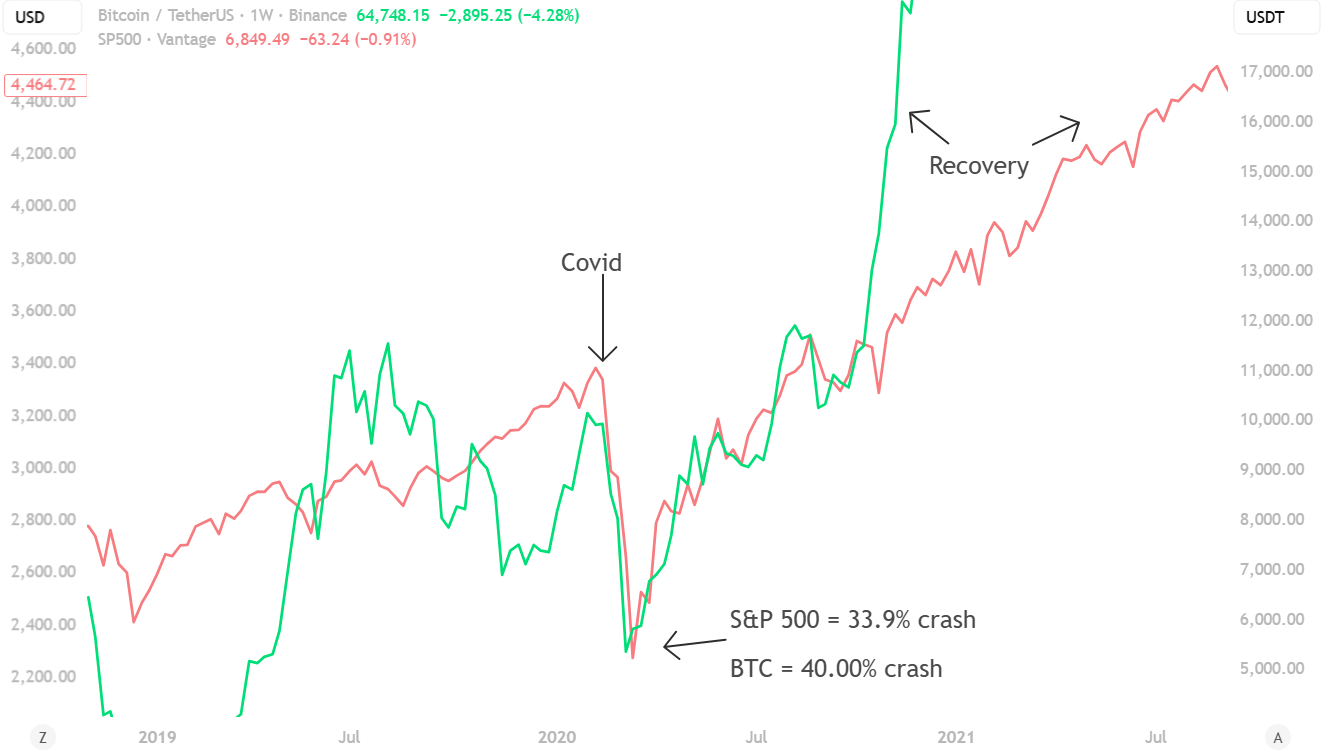
Source: tradingview BTC/USDT & sp500 vantage
5. Crypto is becoming digital assets
The space is evolving beyond speculative tokens.
What began primarily as a retail-driven market has increasingly become infrastructure for digital value transfer.
It now includes:
- Stablecoins
- Tokenised assets
- On-chain settlement infrastructure
- Real-world asset tokenisation
- Institutional rails
This shift matters. Because it changes what the market represents.
Stablecoins as flexibility tools
Stablecoins such as USDT are widely used for:
- Transfers across exchanges
- On-chain payments
- Liquidity positioning
- Settlement between counterparties
Stablecoins settle very large on-chain volumes each month, often in the hundreds of billions (and sometimes much more depending on methodology), though a significant share reflects trading, liquidity flows and on-chain financial activity rather than consumer payments alone
They are not just “parking spots”, they are payment infrastructure.
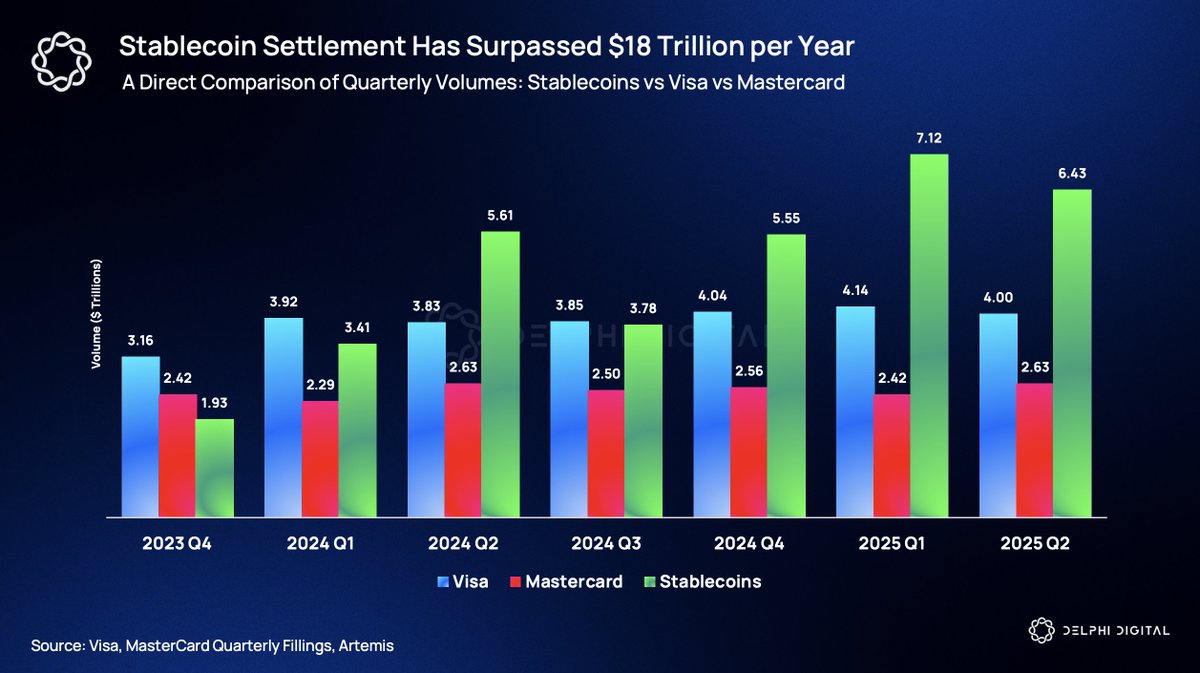
Source: Delphi Digital
Stablecoin settlement volumes have expanded rapidly into the trillions of dollars annually. Exact estimates vary by methodology (for example, raw on-chain transfer volume versus adjusted or payments-focused measures), but the scale highlights how significant digital dollar infrastructure has become
Australian dollar-backed stablecoins such as AUDF represent a broader shift toward digital representations of fiat currency. These can be used for:
- On-chain settlement
- Treasury management
- Faster internal transfers
- Bridging traditional finance and digital assets
In slower markets, some participants use stablecoins for flexibility while researching opportunities. This allows them to remain inside the digital asset ecosystem without full price exposure.
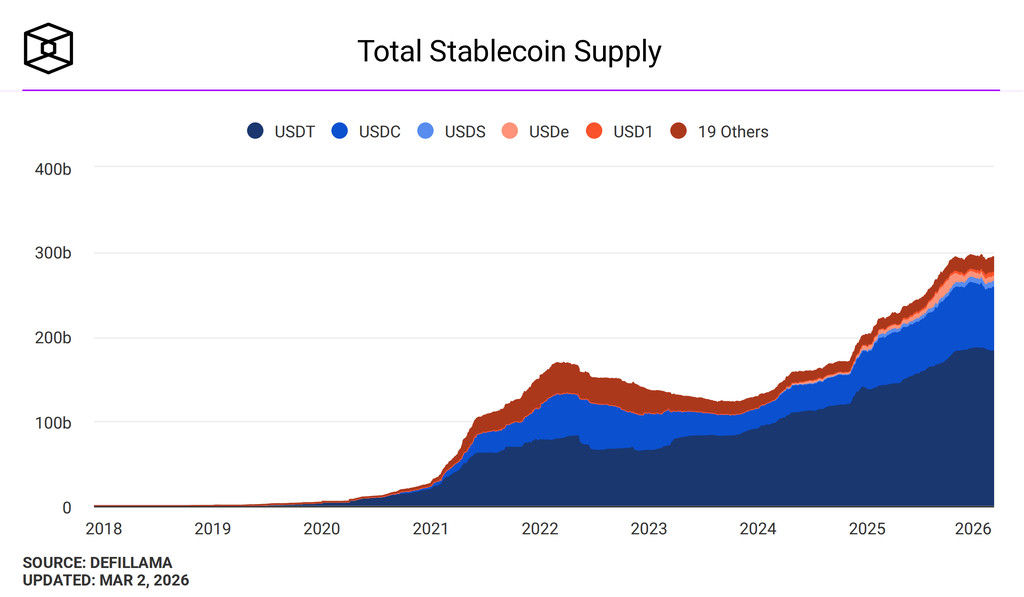
Source: theblock.co
Total stablecoin supply has grown from under $10 billion in 2018 to nearly $300 billion in recent years. While not all of this represents new capital entering crypto, it reflects the rapid expansion of on-chain dollar liquidity and the increasing role of stablecoins in trading, settlement, and digital finance infrastructure.
Zooming out, the bigger story is this:
Stablecoins are increasingly becoming digital settlement layers.
Tokenised assets and real-world integration
Beyond stablecoins, the digital asset space now includes tokenised representations of traditional financial instruments.
These include:
- Tokenised government bonds and treasury products
- On-chain money market funds
- Tokenised real estate and private credit
- Tokenised equities and exchange-traded products
Tokenised financial products are no longer hypothetical, large asset managers and banks are launching or experimenting with on-chain versions of traditional instruments. For example, BlackRock’s BUIDL tokenised Treasury fund provides blockchain access to U.S. treasuries, while Singapore-based OpenEden offers a tokenised U.S. Treasury fund with BNY Mellon as custodian. Major institutions like J.P. Morgan have launched tokenised money market funds on public blockchains, while firms like Circle offer tokenised yield products such as USYC that integrate with stablecoin liquidity workflows.
Major financial institutions are exploring tokenisation to improve:
- Settlement speed
- Transparency
- Capital efficiency
- Cross-border accessibility
This is not about replacing traditional markets overnight.\ It is about modernising how assets move, settle, and integrate with digital infrastructure.
Why this matters in the “boring phase”
When price action slows, it can feel like nothing is happening, but infrastructure often develops quietly.
Understanding this broader evolution can help shift focus from short-term volatility to structural adoption.
Crypto is no longer only about price cycles, it is increasingly about digital financial architecture.
Final thought
The boring phase is not wasted time, it is where discipline is built and where stronger conviction can form. When volatility eventually returns, preparation often matters more than prediction.
Continue learning
Explore more guides, insights and digital asset education in the Cointree Education Hub.
Structured learning and process-driven decision making tend to outperform emotional reactions over time.
This article is for general information only and does not constitute financial advice. It does not take into account your personal objectives, financial situation, or needs. Digital assets can be volatile and involve risk.


