

The Weekly Wrap
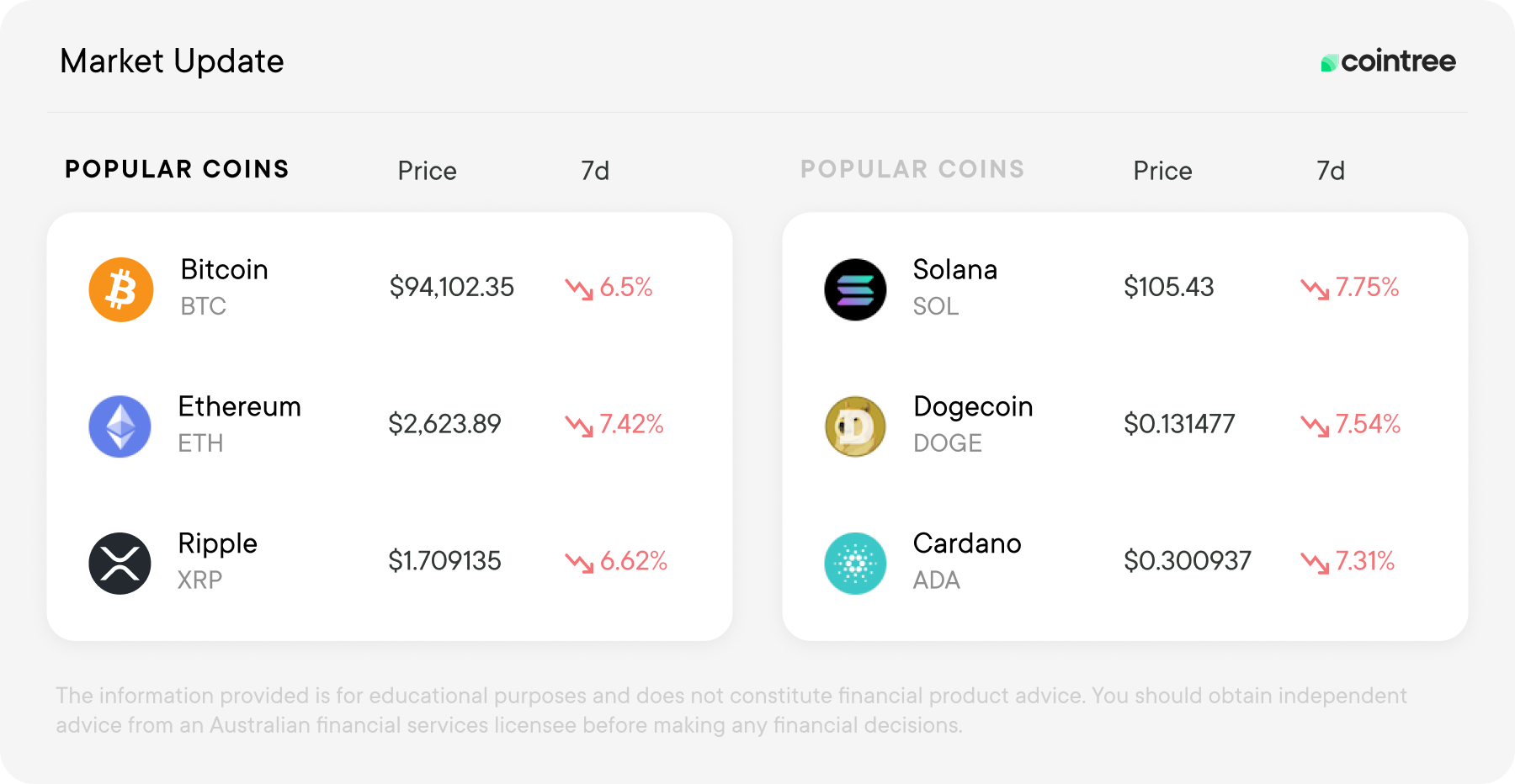

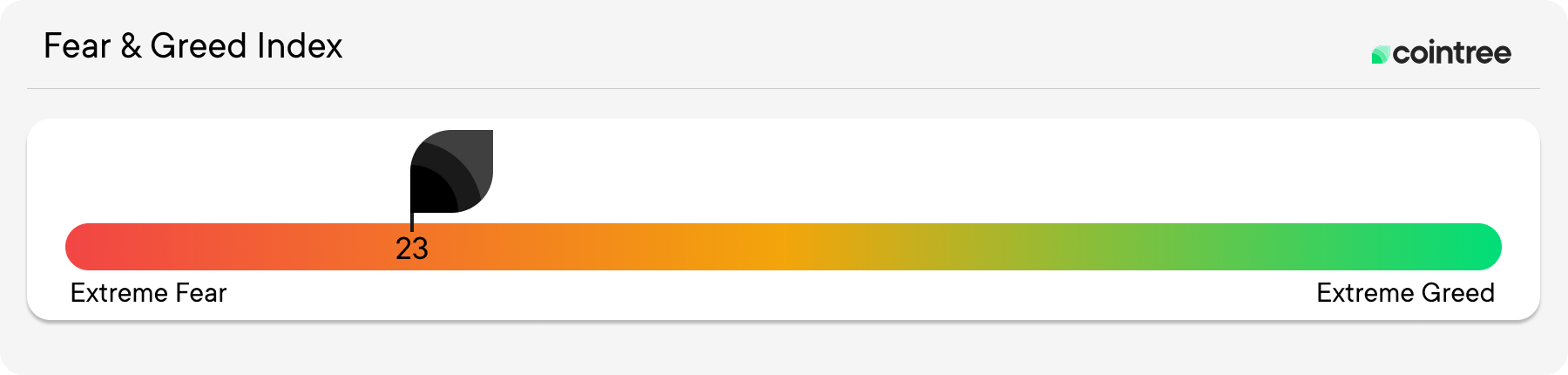
The market remained under pressure this week, with sentiment moving deeper into fear.
The Crypto Fear and Greed Index fell to 23, placing the market back in extreme fear, while the total crypto market cap declined another 8% over the past seven days to around US$2.27 trillion.
ETF flows also stayed negative. Bitcoin ETFs recorded US$1.42 billion in outflows, marking the third straight week of net withdrawals and 10 consecutive trading days of daily outflows. Ethereum ETFs also saw US$241.45 million in outflows, extending their own run to three consecutive weeks in the red.
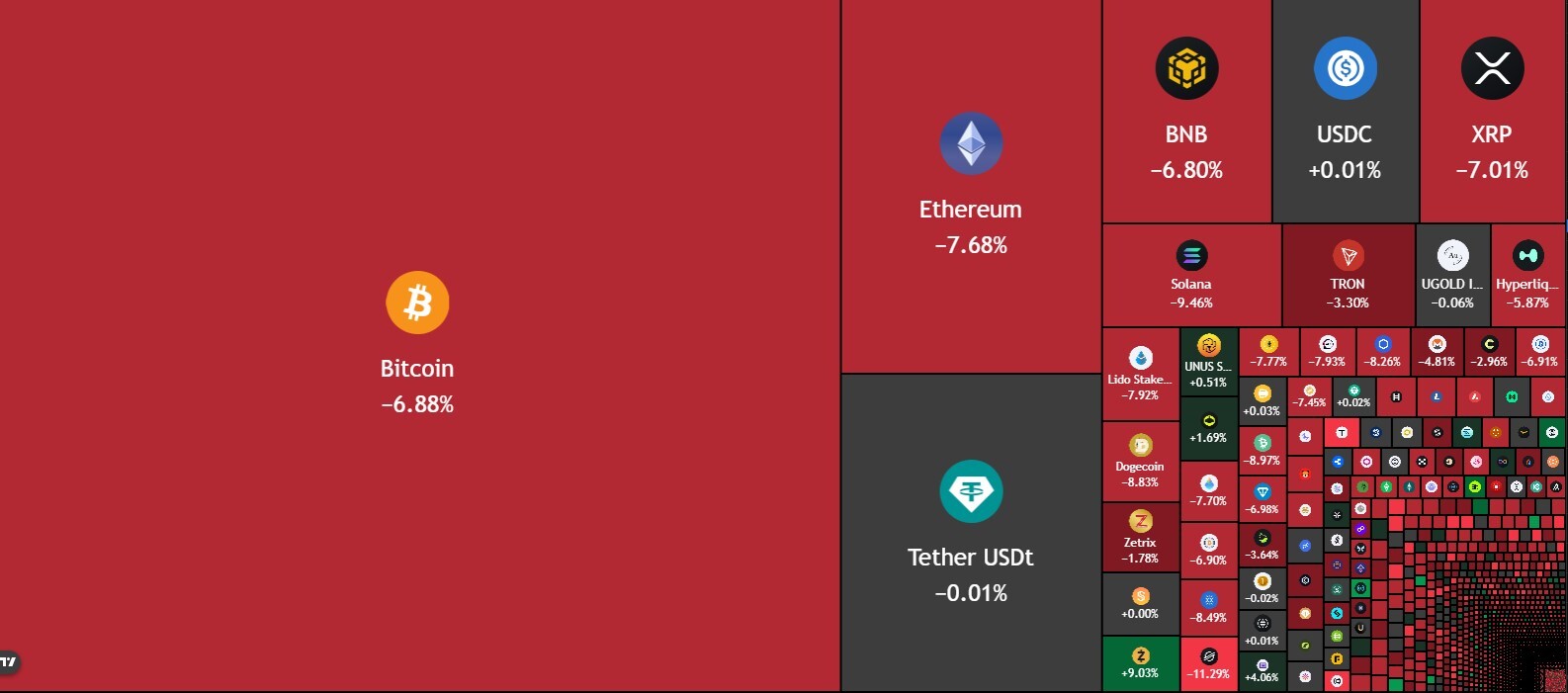
Red dominated the crypto market over the past 24 hours, as selling pressure spread across Bitcoin, Ethereum and most major altcoins.
Bitcoin vs Gold vs Nasdaq YTD
🟡 Gold: +3.12%
🔵 NASDAQ: +19.45%
🟠 Bitcoin: -18.97%
The gap between traditional markets and Bitcoin has widened again this week. The Nasdaq remains the clear leader, now up 19.45% year to date, showing continued strength in growth and tech-related assets.
Gold is still positive for the year, but has cooled to +3.12% after losing momentum from its earlier highs.
Bitcoin, meanwhile, remains under pressure and is now down 18.97% year to date. After attempting to recover through April and May, BTC has rolled over again, highlighting the continued volatility in crypto compared with gold and equities.
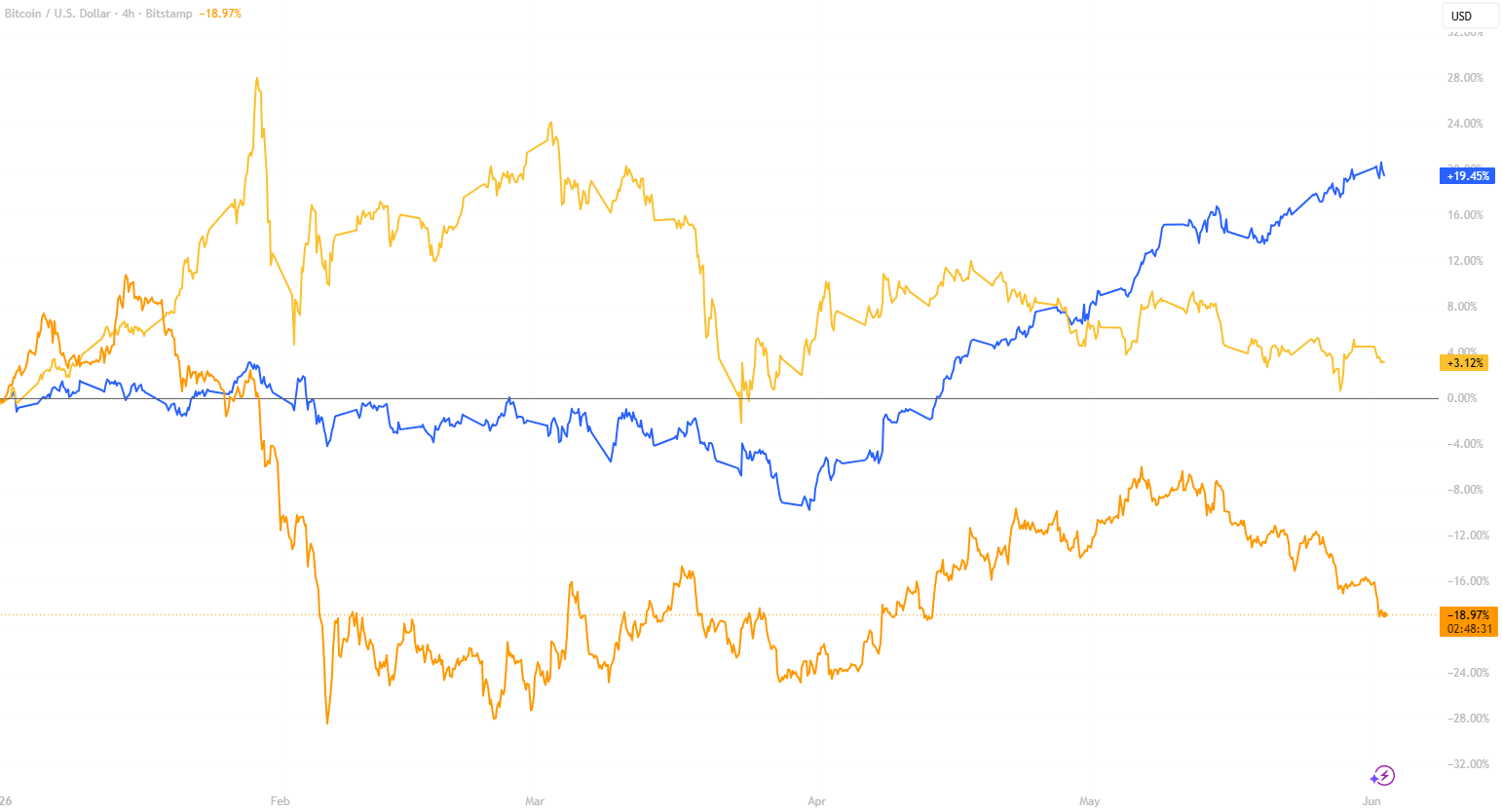
Source: Tradingview, BTC, GOLD, NASDAQ
BTC
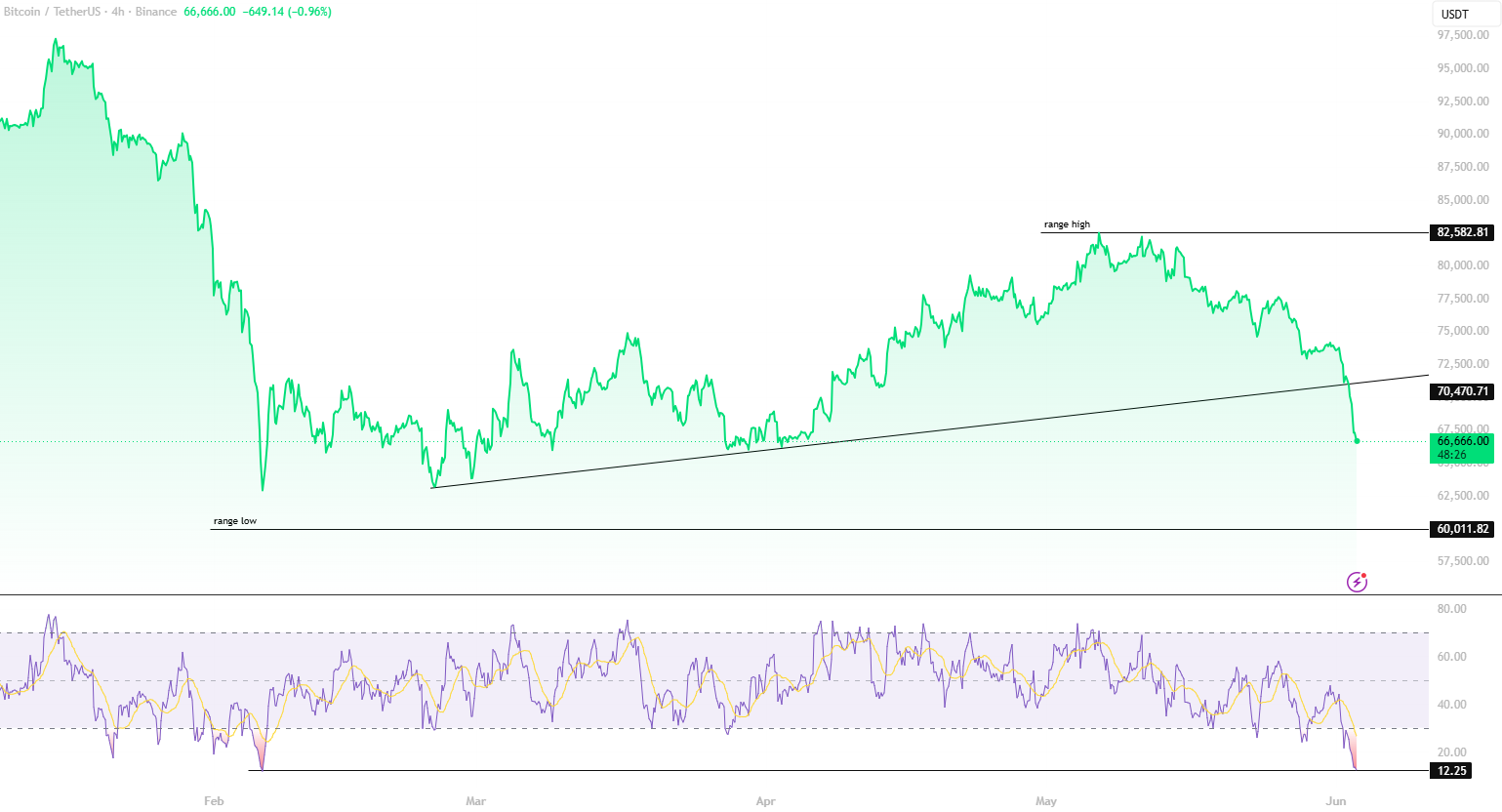
Bitcoin remains under pressure this week, trading near US$66,000 after a sharp move lower from its recent US$82,500 range high.
From a technical view, BTC has now broken below the rising trend line that had been building since late February. That changes the short-term picture, with the previous trend support now at risk of acting as resistance if price attempts to recover. The 4-hour RSI has also moved deep into oversold territory, showing how aggressive the latest sell-off has been. While that can sometimes lead to short-term relief, the broader setup still looks fragile after such a clean break lower.
The next key area to watch is the wider range low near US$60,000. A move toward that zone would bring BTC back to levels last seen during the February and March weakness. On the upside, buyers would need to reclaim the broken trend line and push back above the US$70,000 area to repair some of the damage. For now, Bitcoin is no longer just testing support. It has broken below it, leaving the market in a more cautious position heading into the week ahead.
The news backdrop added to the pressure after Strategy reportedly sold 32 BTC, worth around US$2.5 million, to help fund preferred stock distributions. While the sale was small compared with Strategy’s total Bitcoin holdings, it stood out because the company has long been known for its strong “never sell” stance.
ETH
Ethereum had a busy week, not because of one major price move, but because of the bigger debate around where value is building across the network.
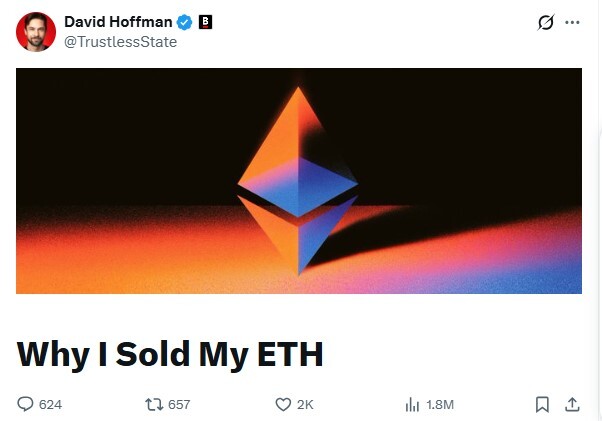
One of the main talking points came from Bankless co-founder David Hoffman, who said he had sold his ETH. His view was not that Ethereum itself is failing. In fact, he said he remains bullish on Ethereum as a network. His concern is more about ETH as an asset, and whether the old “ETH is money” thesis still carries the same weight.
That debate is becoming more relevant as more activity moves across Ethereum’s Layer 2 ecosystem. Base remains the clear standout among optimistic rollups, with daily transaction activity sitting well above Optimism, Arbitrum, Zora, Blast and Mode Network. This is good for Ethereum’s scaling story, but it also raises the question the market keeps coming back to: if more users are moving to Layer 2s, how much of that value flows back to ETH?
There was also another important development on the DeFi side. Vitalik Buterin floated a new options-based model that could reduce the need for sudden liquidations. Instead of relying on collateralised debt positions and fast-moving price oracles, the idea would use options and slower oracles to make DeFi positions adjust more gradually during volatile markets. It is still an early idea, but it shows Ethereum is continuing to think seriously about how DeFi can become safer and more stable.
Overall, Ethereum remains one of the most important networks in crypto, but ETH itself is still facing a harder question. The ecosystem is growing, Layer 2 usage is strong, and DeFi is still evolving, but investors are watching closely to see whether that growth is reflected in the asset itself.
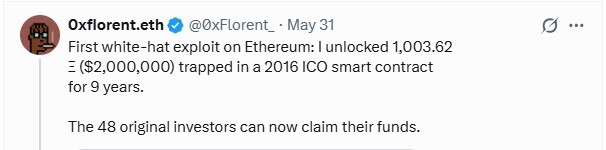
A rare good-news story came out of Ethereum this week, after a security researcher helped recover more than 1,000 ETH that had been stuck in an old 2016 ICO contract for nearly nine years. The funds were linked to Hongcoin, an early Ethereum project that failed to reach its funding target. Investors were meant to receive refunds, but a bug in the contract left most of the ETH locked and unable to be claimed.
A whitehat researcher known as 0xflorent found a way to safely unlock the funds using an old vulnerability in the contract’s admin function. Importantly, the recovery did not allow funds to be stolen or redirected. It only allowed the original contributors to claim what they were already owed.
In total, around 1,003 ETH was unfrozen, worth roughly US$2 million. Some investors have already started claiming their refunds, while more remains available for others who contributed to the original ICO. It is a small but interesting reminder that crypto’s early years still have unfinished stories buried on-chain. Some old contracts from the ICO era still hold funds that many people wrote off years ago, and with the right tools, some of those funds may not be lost forever.
ALTCOINS
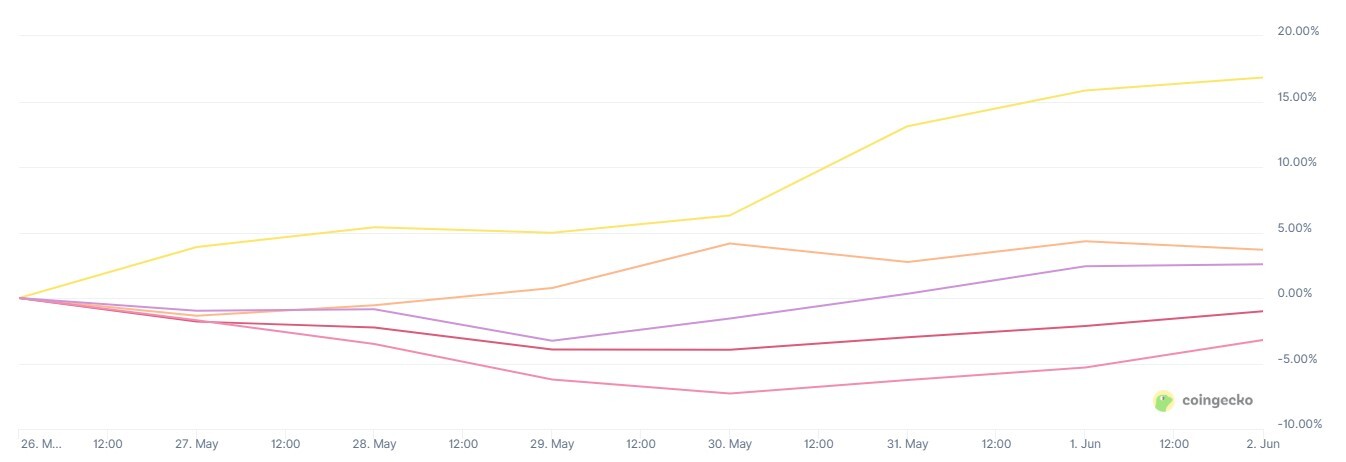
\ Real World Assets (RWA): +3.68%
Decentralized Finance (DeFi): +16.83%
Gaming (GameFi): +2.58%
Meme: -1.01%
Artificial Intelligence (AI): -3.20%
Altcoin sectors were mixed this week, but DeFi was the clear standout, gaining 16.83% over the past seven days. INJ and HYPE both gained over 25% for the week. Real World Assets also finished higher, up 3.68%, while Gaming managed a modest 2.58% gain.
Meme coins were slightly weaker, slipping 1.01%, while AI was the softest category, falling 3.20%. After recent volatility across altcoins, this week’s moves show investors rotating back into DeFi, while AI and meme-related tokens remain under pressure.
Source: Coingecko categories
Coin of the week: XLM
XLM was one of the standout movers this week, up 60.50% at the time of writing and pushing into the top 15 crypto assets by market capitalisation, with a market cap of just over US$8 billion.
Stellar was one of the more interesting ecosystem stories this week, with several updates pointing to growing real-world payment and tokenisation activity.
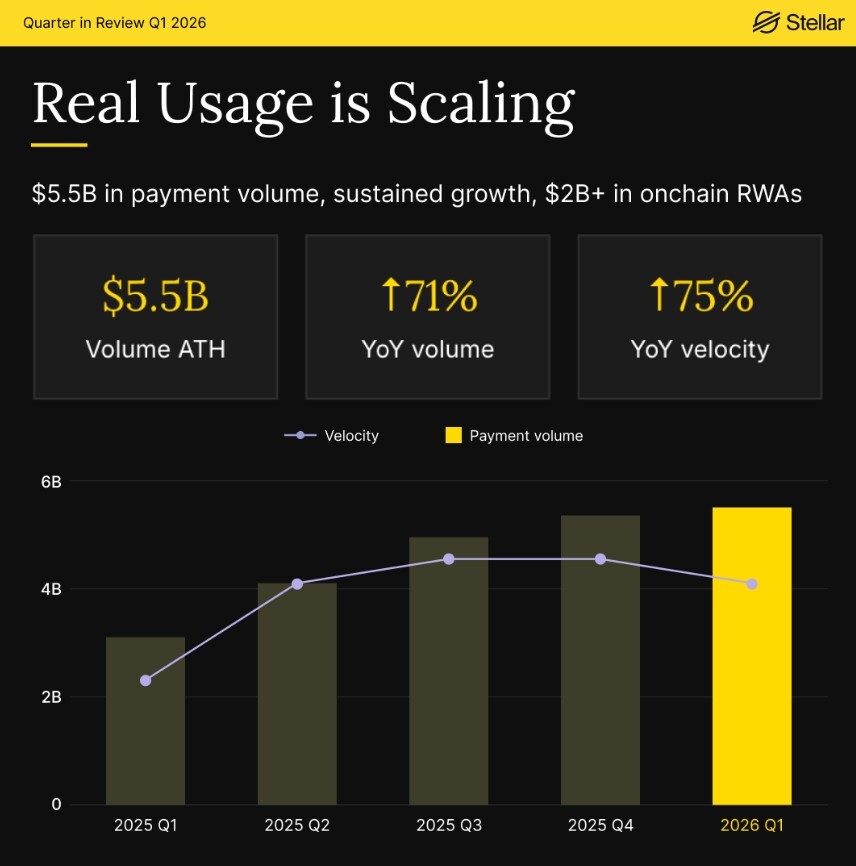
The Stellar network reported a strong Q1 2026, with payment volume reaching US$5.5 billion, up 71% year on year, while network velocity increased 75%. The ecosystem also highlighted more than US$2 billion in on-chain real-world assets.
There were a few major updates behind the renewed attention. Bermuda selected Stellar to support its sovereign digital dollar, while DTCC announced plans to connect its tokenisation service with the Stellar public blockchain. The proposal would allow certain DTC-custodied assets to be tokenised on Stellar, with eligible assets expected to become available in the first half of 2027.
The update is notable because DTCC sits at the centre of traditional market infrastructure, and its planned connection with Stellar could help bring regulated assets such as ETFs, US Treasuries and other highly liquid securities into tokenised form.
Stellar also saw new DeFi-style activity, with Peridot launching cross-chain lending and borrowing functionality on the network. Circle’s Cross-Chain Transfer Protocol also went live on Stellar, allowing USDC to move more easily between Stellar and 20+ other supported networks.
Together, the updates show Stellar continuing to position itself as a payments, settlement and tokenisation network rather than a pure DeFi chain. For XLM, the bigger story this week was the continued push toward real-world financial infrastructure.
THIS WEEKS INSIGHTS
Are AI agents made for crypto?
AI agents are quickly moving from simple tools to software that can act, decide and complete tasks on behalf of users. That shift raises a big question: how does software pay for things?
Traditional payment systems are still built around people, identity checks, cards and bank accounts. Crypto works differently. Wallets, stablecoins and smart contracts give software a way to hold value, send payments and follow rules in code.
In this week’s insights article, we look at why crypto may be difficult for humans, but naturally suited to AI agents, especially as machine-to-machine payments, micropayments and agent-driven workflows become more common.
Read the full article: https://www.cointree.com/news/are-ai-agents-made-for-crypto/


