

Could AI Agents Become Crypto's Ultimate Power Tool?
A recent Bankless conversation sharpened a view I’ve been circling for a while: crypto may have spent a decade trying to become easier for humans, only for us to realise it might be naturally better suited to software.
It may sound strange at first. For most people, crypto feels risky and hard to use. You have to double-check every address, every website, and every approval. One wrong move can be expensive.
An AI agent does not deal with crypto that way. It reads the rules, checks the details, and follows the process.
That is the real starting point: Agents can’t open a bank account.
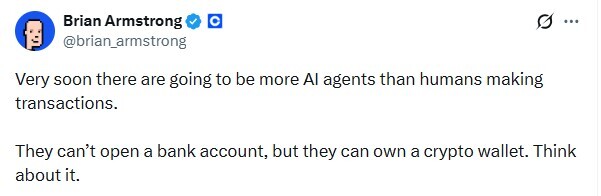
That line matters more than it sounds. Banks are built for people and legal entities. They are built for named customers, verified businesses, trusts, and directors. They are built around forms, identity checks, ownership rules, and approval chains. That system makes sense when a human or a company wants to move money. It makes far less sense when software wants to act.
That is the shift you need to pay attention to. AI is moving from being a tool you use to being a system that does work for you. In some cases, it will do work with you. In time, parts of it will act with more freedom inside rules you set, that creates a new question.
How does software pay? Right now, most payment systems still assume a human sits at the centre. A person signs in. A person enters their card. A person approves the payment. A person handles the dispute if something goes wrong. That works for online shopping, it does not work nearly as well for autonomous software.
An AI agent will not behave like you. It will not browse like you. It will not think in monthly subscriptions, card forms, or office hours. It will behave like software. It will need to call services, access tools, pay for data, rent computers, and settle tiny amounts of value as it works. Sometimes that payment might be large, a lot of the time, it will be small, that is why crypto makes sense.
Crypto gives software something traditional finance struggles to offer. It gives it a native way to hold value, send value, and follow rules in code. Wallets are programmable. Permissions are programmable. Settlement is programmable. Smart contracts are readable by machines in a way legal agreements are not. That does not always feel good as a human user, in fact, that has been one of crypto’s biggest problems.
Humans are bad at crypto UX. You have to check wallet addresses. You worry about phishing links. You second-guess approvals. You sign transactions while hoping you did not miss something buried in the details. Even experienced users still feel that tension.
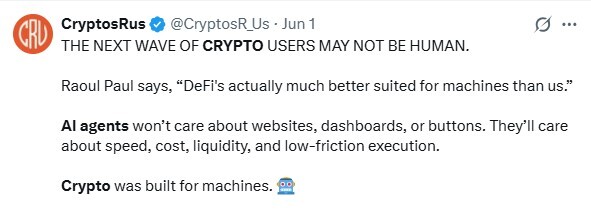
An agent sees that world differently, it does not get tired, it does not rush, it does not forget to check the steps. It reads structured data, rules, conditions, and outputs. It works inside systems that are much closer to code than to human judgment. That is why I think one of crypto’s biggest weaknesses for humans could become one of its biggest strengths for AI. Crypto was not built around human comfort, it was built around machine-verifiable rules.
That matters because AI agents are coming fast. Gartner expects agentic AI to move from a niche feature to a major part of enterprise software over the next few years. More software will act, decide, and execute with less human involvement. That does not mean fully independent robot economies arrive tomorrow. It does mean more of your workflows will have software making decisions and taking actions on your behalf. Once that happens, payment becomes infrastructure, not a product, not a feature, infrastructure, and that is where the differences between payment rails start to matter.
The incumbents are not asleep.
Visa, Mastercard, Google, Stripe, and PayPal are already building for agent payments. They are not waiting for agents to open their own bank accounts. They are giving them delegated access instead. In that model, the human or business passes the identity checks, and the agent operates inside those permissions. That is a serious answer to the problem. It works well for a world where your agent shops for you, books for you, or checks out for you using your existing payment identity and protections, but that is not the whole market. Crypto still looks stronger in a different lane: machine-to-machine payments, internet-native micropayments, on-chain activity, and software paying software directly in open environments. That is the nuance that matters. Traditional rails may win agent checkout. Crypto may win agent-native money movement.
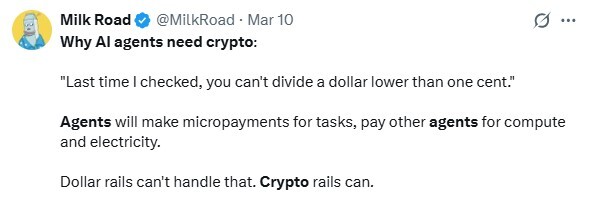
Card networks are adapting and banks will adapt too, but they still sit on top of systems built around human identity, human approval, and human dispute resolution. Those systems are strong for consumer protection. They are familiar, and they are trusted, but they are not naturally built for software paying software all day, every day, across borders, in tiny increments. Crypto is much closer to that model already and that is why internet-native payment standards matter.
Standards are already emerging to support this shift. x402 is built for simple, internet-native payments between software systems. ERC-8183 tackles the bigger commerce problem by adding escrow, verification, and settlement rules around a job. That is an important difference. One helps agents pay. The other helps agents complete trusted work and settle it properly. The agent economy will likely need both.
The idea behind protocols like x402 is simple. Let software pay over the internet as part of the request itself. No messy sign-up flow. No manual invoice. No forced subscription when all you needed was one API call, one dataset, one burst of compute, or one action, that is a big deal.
It means an agent could pay for exactly what it needs, when it needs it. It could buy access to a tool. It could pay another agent for a service. It could pay for storage, inference, bandwidth, research, or execution. It could do that instantly and keep moving. That is how software wants to work.
Stablecoins make that even more important. You now have dollar-linked assets that move on open networks, around the clock, with no banking hours and no cross-border friction in the old sense. Stablecoins are not some side story anymore. They are starting to look like the settlement layer for internet money. Put those pieces together and the picture gets clearer, agents will first work for you.
That is the near-term version that matters most. You set the rules. You set the budget. You define the risk. The agent does the work. It might rebalance your on-chain positions. It might source the best service for a task. It might compare prices, route payments, and execute a plan you approved in advance. You stop clicking through every step and you move up a level.
Instead of telling software exactly how to do something, you tell it what outcome you want and what boundaries it must respect, that is a much better model for most people.
Later, some agents will look like they work for themselves. They will sell services. They will buy inputs. They will interact with other agents, as early experiments like OpenClaw hint at. They will form loose machine-to-machine markets around data, access, computation, automation, and digital work. That world will not be clean and it will not be perfectly safe either.
You will see abuse. You will see scams. You will see agents used badly, just like you will see them used well. AI will not remove human greed, stupidity, or fraud. It will scale some of it. That is real. It is one of the strongest arguments for building payment systems with strict controls, clear permissions, and full traceability. That risk does not weaken the crypto case, it strengthens it.
If agents are going to move money, you need a form of money that software can actually use. You need rules in code. You need programmable limits. You need systems that can support tiny payments, fast settlement, and machine-driven action without forcing every step back through human-heavy finance rails. That is why I think the market keeps circling back to this idea. Crypto may never be the perfect interface for people, but it may be the best financial rail for software which is a big difference, and it changes how you should think about adoption.
For years, crypto tried to win by asking humans to become more technical, more careful, and more comfortable with raw financial infrastructure. That only got it so far. The next wave may look very different. Instead of teaching every human to think like a machine, we may let machines handle the parts of finance they are naturally better at. That is the real opportunity, not humans becoming more like crypto users but software becoming the kind of user crypto was built for in the first place because agents can’t open a bank account, but they can open a wallet.


