

What Is Market Cap in Crypto? Market Cap vs Price Explained
"When PEPE Hits $1, I'm a Multimillionaire" | Why Market Cap Ruins the Dream
My dad has a plan. He holds a bag of PEPE, and whenever crypto comes up when we see each other, he says the same thing: "If PEPE goes to $1, I'm a multimillionaire." I love the optimism. There's just one problem, and it's called market cap.
The maths that ruins the dream
Market cap is one of the simplest formulas in crypto:
Price × Circulating Supply = Market Cap
PEPE has a circulating supply of around 414 trillion tokens. For PEPE to reach $1 USD, its market cap would need to hit roughly $414 trillion USD.
For context:
- Bitcoin, the largest cryptocurrency in the world: around $1.3 trillion USD
- The entire crypto market combined: around $2.3 trillion USD
- Everything the world produces in a year (global GDP): around $126 trillion USD
- The entire global stock market: roughly $152 trillion USD
- The combined net worth of every person on Earth: roughly $520 trillion USD
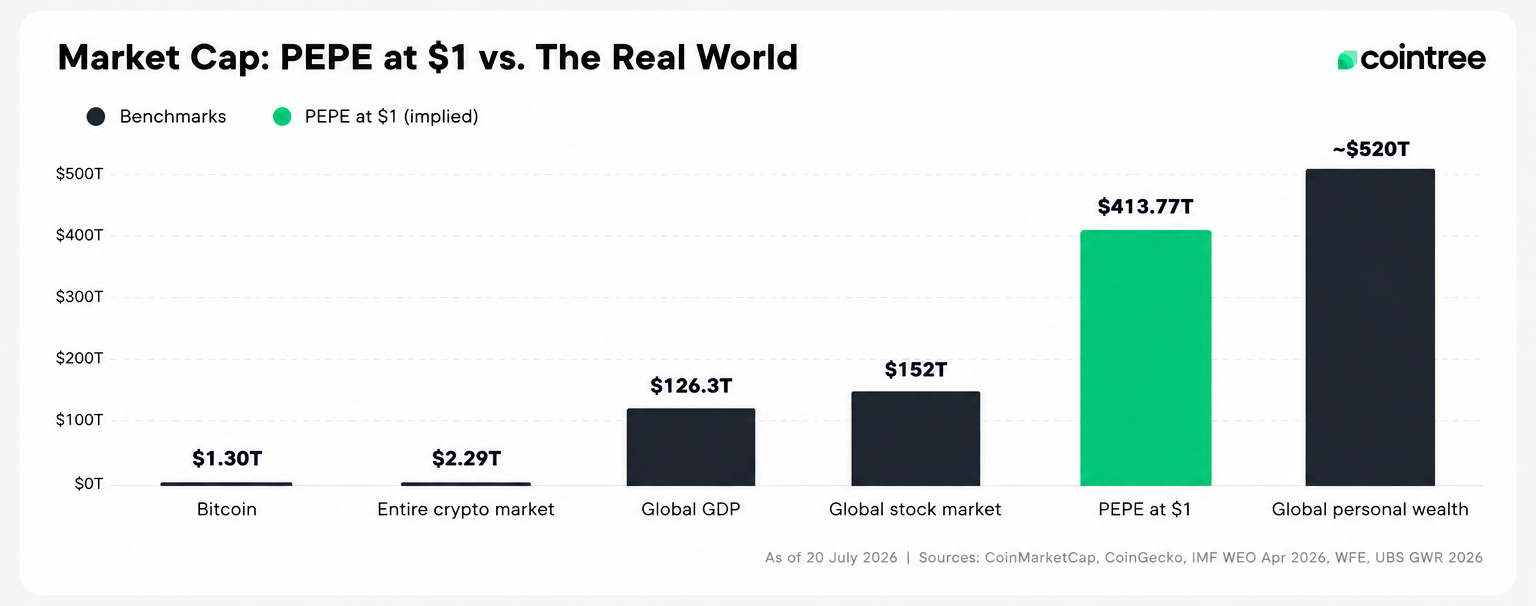
So for dad's plan to work, PEPE would need to be worth more than three times everything the entire world produces in a year. Every product made, every service delivered, every haircut, every iPhone, every tonne of steel, the whole planet's annual output, more than tripled.
Or put another way: PEPE would need to swallow about 80% of the entire net worth of humanity. Every house, every share, every bank account, every asset owned by every person on Earth, four out of every five dollars of it, parked in a frog meme.
Sorry dad.
The 350,000x problem
Here's another way to look at it. PEPE currently sits at a market cap of around $1.18 billion. To reach $1, it would need to grow roughly 350,000 times over.
For perspective, if you'd bought Bitcoin at $1 back in 2011, one of the greatest investments in modern history, you'd be up around 63,000x at today's prices. Dad's plan needs PEPE to do more than five times better than that.
Price tells you almost nothing
Here's the big unlock: a coin's price on its own is nearly meaningless. What matters is price relative to supply.
A coin priced at $0.00001 isn't "cheap" and a coin priced at $60,000 isn't "expensive." If the first one has 400 trillion tokens and the second has 19 million, the "cheap" one might actually be the bigger asset.
This is why "it only needs to go up a few cents" is the most expensive sentence in crypto. A few cents on a supply of hundreds of trillions means trillions of dollars of new money that has to come from somewhere.
This is why Bitcoin is #1
Ever wondered what those rankings on Cointree or Coingecko actually mean? It's not price. It's market cap.
Source: Coinmarketcap.com
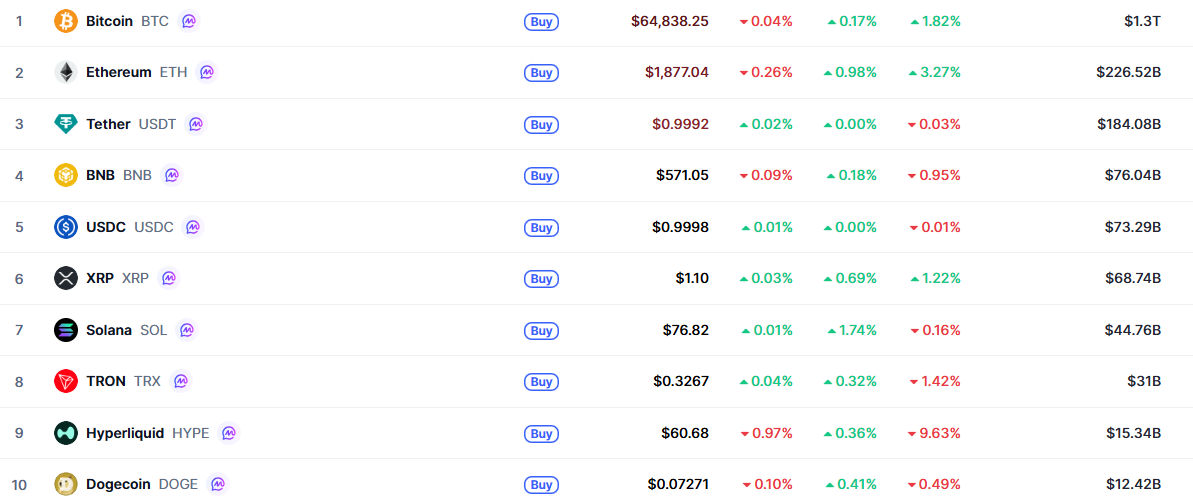
Bitcoin sits at #1 with a market cap of $1.3 trillion, even though one BTC costs about $64,830 USD. Ethereum holds #2 at $226 billion, with ETH priced around $1,877 USD. And Tether (USDT) ranks #3 at $184 billion, despite each USDT being worth exactly... one dollar.
That last one is the giveaway. A coin priced at $1 outranks thousands of coins with higher prices, because there are around 184 billion USDT in circulation. Price didn't earn Tether that spot, supply did.
Look one row further down and it gets even clearer: BNB sits at #4 with a price of $571 USD, more than 500 times Tether's price, yet ranks below it. And XRP at $1.10 USD ranks #6, ahead of Solana at $76.84 USD. The prices are all over the place, but the market caps line up in perfect order, because that's what the ranking actually is.
If rankings were based on price alone, the leaderboard would be nonsense. Market cap is what lets you compare a $64,000 coin, a $1 coin and a $0.000003 coin on equal footing: total value, not sticker price.
A better way to compare coins
Instead of asking "what's the price?", ask "what's the market cap?" That's when real comparisons become possible.
Try this sanity check on any coin: for it to hit your dream price, what market cap would that require? Now put that number next to Bitcoin. Next to Apple. Next to the entire crypto market. If the answer sounds like science fiction, the price target probably is too.
The recap
- Market cap = price × circulating supply
- Price alone tells you nothing without supply
- "Cheap" coins with massive supplies aren't cheap
- Before dreaming of a price target, check what market cap it implies
Try it yourself
Next time you're eyeing a coin, give it the two-minute reality check. Log in to Cointree in your browser, open the coin's page, and find its market cap. Then ask: what would that number need to become for my dream price to happen? If the answer is "bigger than the global stock market," you have your answer. If it's something plausible, then you're making a decision with your eyes open, and you can trade or set a price alert right there.
That's the whole trick. Dad's plan didn't fail because PEPE is a bad meme, it failed because nobody checked the supply. Two minutes of maths beats a lifetime of waiting for a frog to outgrow the global economy.
And dad, if you're reading this: I'm not saying sell. I'm just saying maybe don't put a deposit on the yacht yet.


