

Big Macs, iPhones and Bitcoin: What Changed in 10 Years?
Ten years ago, AUD 5.75 got you a Big Mac, petrol was about AUD 1.12 a litre, a basic loaf of white bread was around AUD 1.90, and if you wanted Apple's latest iPhone, you were looking at roughly AUD 1,079.\ \ Fast forward to 2026 and your wallet needs to work a little harder. A Big Mac is around AUD 8.50, petrol is about AUD 2.05 a litre, a comparable loaf of white bread is AUD 3.30 and the latest base iPhone starts at AUD 1,399.
So what got hit hardest?
Petrol wins, if you can call it winning
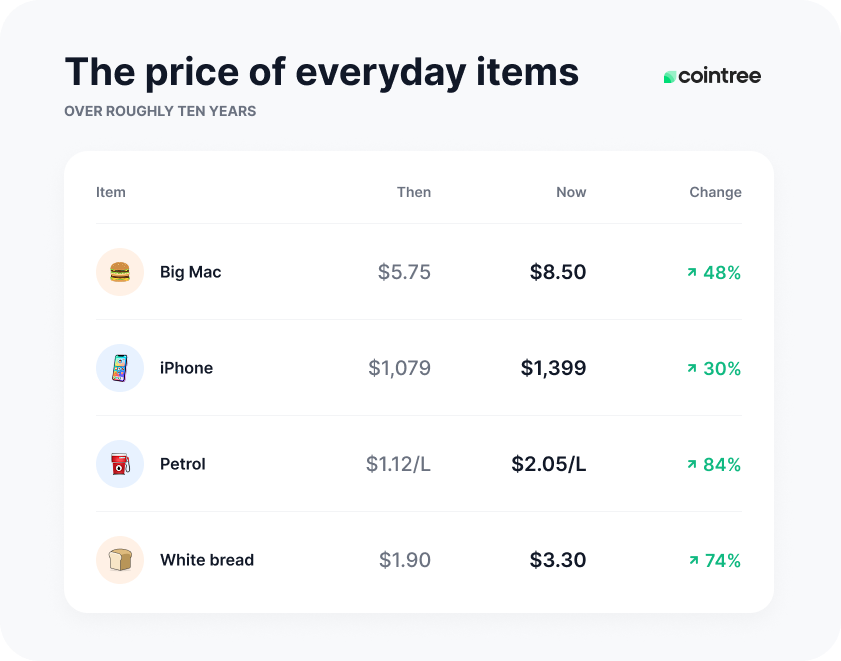
Petrol takes the unwanted gold medal.
There is some context needed here. Fuel prices can swing wildly with oil markets, exchange rates, taxes and geopolitical events. Australia's current petrol prices are particularly elevated, with national U91 prices sitting at around AUD 2.05 a litre.
Bread and burgers have had their own pressures from wages, ingredients, transport and operating costs.
Then there is the iPhone…
Its sticker price has risen the least of our four products, despite the phone itself changing considerably. The base iPhone 6s sold for AUD 1,079 with 16GB of storage. Today's AUD 1,399 iPhone 17 starts with 256GB.
So simply saying "iPhones are 30% more expensive" misses quite a lot, but we're a crypto exchange, so let's make this comparison a little stranger.
What if we priced everything in Bitcoin?
On 24 August 2016, one Bitcoin was worth roughly AUD 764. Today, it is around AUD 108,224. Now our shopping list looks completely different.
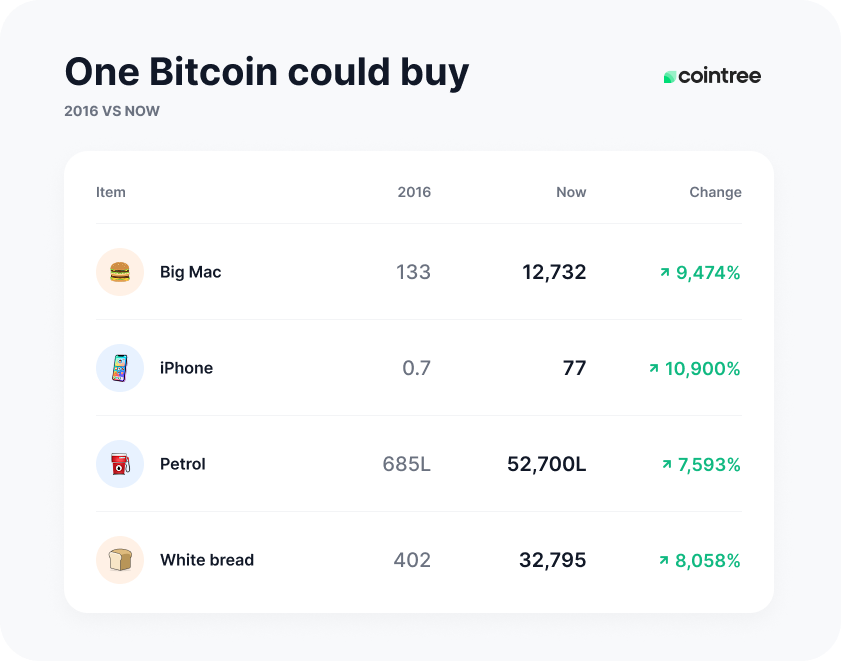
That’s right, one whole Bitcoin couldn't buy Apple's base iPhone. Today, McDonald's might have some questions.
Take the Big Mac another way. In 2016, that AUD 5.75 burger cost roughly 753,000 satoshis, the smallest standard unit of Bitcoin. Today, an AUD 8.50 Big Mac works out to roughly 7,850 sats. The burger became almost 50% more expensive in Australian dollars while becoming dramatically cheaper when measured in Bitcoin.
How can both be true?
It's all about what you're measuring against
Nothing magical happened to the burger, we just changed the denominator. Australians naturally measure prices in dollars because our salaries, bills and everyday purchases are generally denominated in AUD, but every price is really a comparison.
AUD 8.50 tells you how much Australian currency is required to buy a Big Mac. Around 7,850 sats tells you how much Bitcoin is required to buy the same thing at today's prices.
Bitcoin's Australian-dollar price has increased enormously since 2016, so almost anything priced against it over that particular ten-year period looks much cheaper. That doesn't mean Bitcoin's purchasing power rises neatly every year, far from it.
Bitcoin remains highly volatile. Its BTC/AUD price has traded across a huge range over the years. Pick different starting and finishing dates and the numbers can change substantially. This also isn't an inflation index, four products don't tell us what is happening across the entire Australian economy, but they do show something that's surprisingly easy to forget.
The price of something depends on what you're pricing it in.
Ten years ago, one Bitcoin couldn't buy you an iPhone. Today, at current prices, it could theoretically buy around 77. Same type of product, same Australian dollars, a very different measuring stick.


