

What are MSTR and STRC, and why is everyone talking about them?
Michael Saylor is one of Bitcoin’s most recognised public supporters. He is the founder and Executive Chairman of Strategy, the company formerly known as MicroStrategy. Saylor served as CEO from 1989 to 2022, before moving into the Executive Chairman role to focus more on the company’s Bitcoin strategy. Strategy started as a business intelligence software company, but today it is better known for its Bitcoin holdings.

It is now widely seen as the world’s largest public Bitcoin treasury company, using capital markets to raise money and buy Bitcoin. Strategy says it held 846,842 BTC as of 15 June 2026, acquired at an average price of US$75,656 per Bitcoin. (“Strategy - Bitcoin Holdings & Analysis”)

(“Strategy - Bitcoin Holdings & Analysis”)
What is MSTR?
MSTR is Strategy’s common stock. When investors buy MSTR, they are buying shares in Strategy itself. That gives them exposure to the company’s software business, its Bitcoin holdings, its debt, its capital raises and the market’s view of Michael Saylor’s Bitcoin strategy.
In simple terms, MSTR trades like a leveraged Bitcoin proxy. When Bitcoin rises, MSTR can often move harder. When Bitcoin falls, MSTR can also fall harder. That is because the company’s value is heavily tied to its Bitcoin stack, but it also has debt, preferred shares, dividend obligations and shareholder dilution to consider.
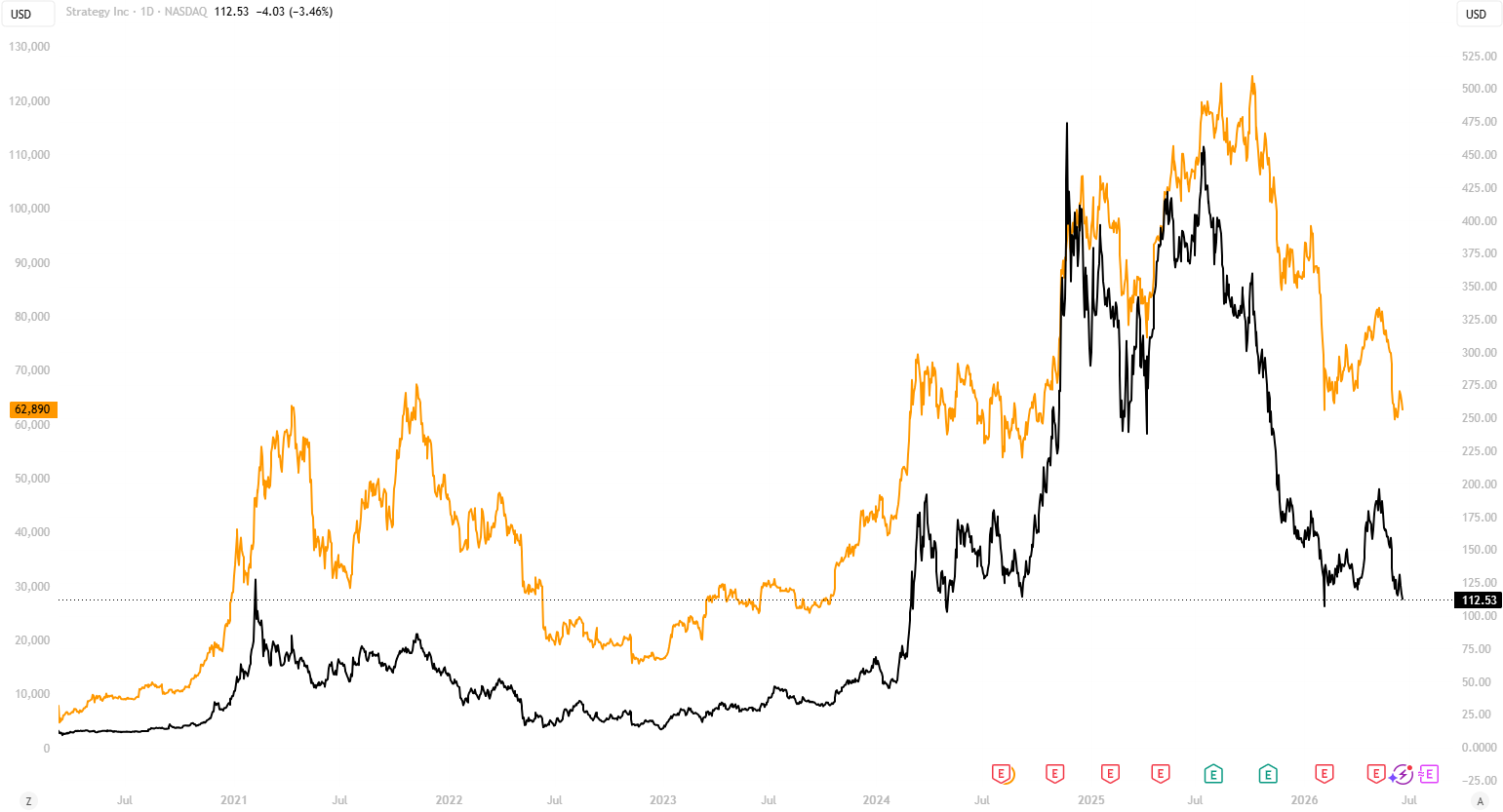
That relationship can be seen clearly in the chart above. MSTR (black line) has closely tracked Bitcoin (orange line) through both bull and bear markets, but with much larger swings in each direction. MSTR is currently down around 79% from its all-time high, while Bitcoin is down around 48.91% from its peak. To reclaim those highs, MSTR would need to rise roughly 384%, compared with around 95% for Bitcoin. This helps explain why many investors view MSTR as a magnified Bitcoin trade. It can outperform strongly when market conditions are favourable, but it can also experience much deeper drawdowns when sentiment turns. (“TradingView”)
What is STRC?
STRC, also called Stretch, is Strategy’s perpetual preferred stock.
Unlike MSTR, STRC is not common equity. It is closer to an income product. Strategy says STRC currently pays an 11.50% annualised dividend, paid twice monthly in cash. The dividend rate is adjusted monthly to encourage STRC to trade near its US$100 par value.
That US$100 level is important. STRC was designed to trade close to par, offering a high yield with lower volatility than MSTR. But in recent weeks, that structure has come under pressure.
STRC recently fell to US$88.59, after trading as low as US$82.61 intraday. That placed it well below the US$100 level it was designed to stay close to.
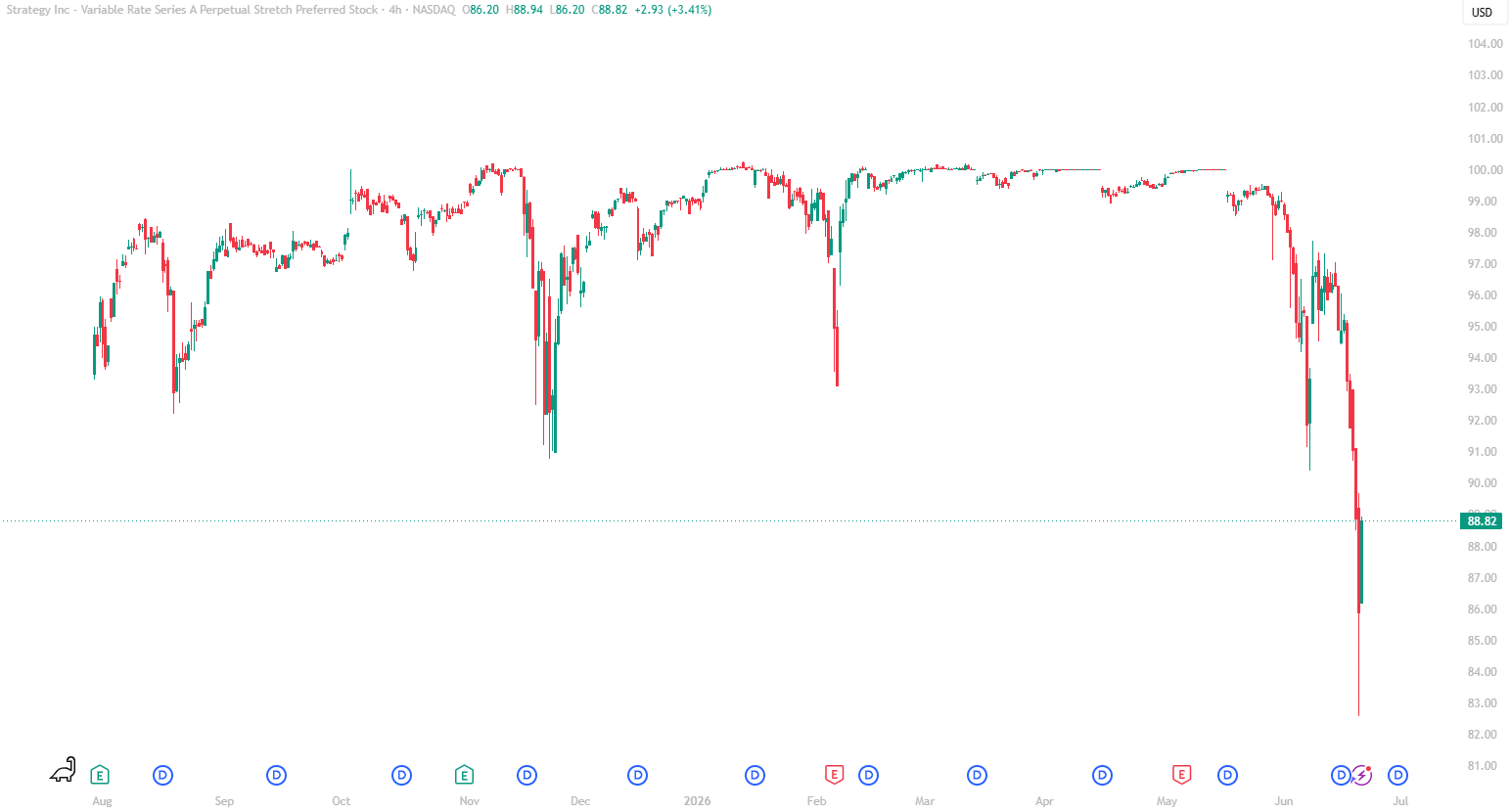
(“TradingView”)
How do MSTR and STRC work together?
Strategy uses different financial products to raise capital. That capital can then support the business, fund obligations or help the company buy more Bitcoin. MSTR is the common stock, STRC is one of the preferred stock products.
When STRC trades near US$100, it can be a useful funding tool for Strategy. Investors get a high dividend, while Strategy gets access to capital. That capital can help support the broader Bitcoin treasury strategy. But when STRC trades below par, the machine gets harder to run.
A key concern in the market is that if STRC stays meaningfully below US$100, Strategy’s ability to issue more STRC through its at-the-market program becomes less attractive. CoinDesk reported that STRC’s fall below par weakened one of Strategy’s main funding channels and limited its ability to keep adding Bitcoin through that route. That is why people keep talking about the “Saylor bid”.
Why did STRC fall?
There is no single reason, but a few factors are being discussed.
First, Bitcoin has been under pressure. Strategy’s Bitcoin holdings were acquired at an average price of US$75,656, while Bitcoin has recently traded below that level. That makes the company’s Bitcoin position look less comfortable than it did when BTC was trading higher.
Second, investors are watching dividend coverage. STRC pays a high cash dividend, but cash dividends require cash. Strategy notes that STRC dividends are not guaranteed, and its preferred securities are not collateralised by the company’s Bitcoin holdings.
Third, STRC is facing competition. Strive’s SATA preferred stock has been compared against STRC because it has offered a higher yield and more frequent dividend payments, which may have attracted income-focused investors away from STRC.
Finally, there may have been a leverage flush. A large sell-off in income products can trigger forced selling, margin pressure and panic. That does not always mean the underlying credit has immediately broken, but it can expose how fragile a crowded trade has become.
What STRC’s sell-off means for MSTR, Bitcoin and crypto markets
STRC’s sell-off has become a bigger talking point because it tests one of the most watched Bitcoin treasury strategies in the market.
Strategy has shown that public companies can use capital markets to build large Bitcoin positions. That approach worked especially well when Bitcoin was rising, investor demand was strong and Strategy could raise capital on favourable terms.
The question now is whether the same model works as smoothly when Bitcoin is falling, funding becomes more expensive and investors start demanding higher yields.
That does not mean Strategy’s model is broken. It just means the market is paying much closer attention to how the structure holds up under pressure.
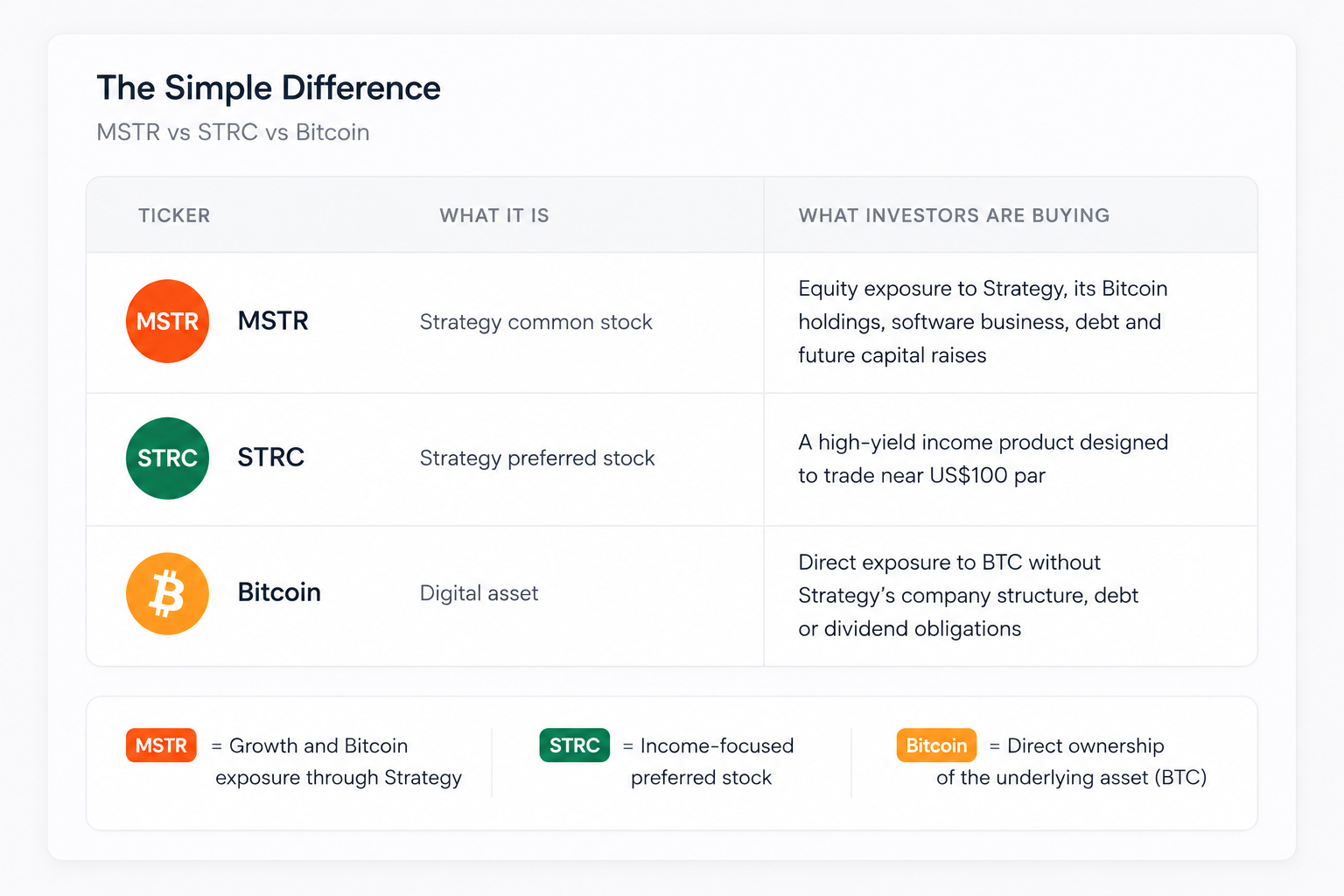
For investors, the key point is that MSTR, STRC and Bitcoin are connected, but they are not the same trade.
MSTR gives investors equity exposure to Strategy’s Bitcoin strategy.
STRC gives investors preferred income exposure to Strategy.
Bitcoin gives investors direct exposure to BTC itself, without Strategy’s company structure, debt, dividend obligations or dilution risk.
The recent volatility is a reminder that Bitcoin-linked financial products can carry risks that are different from holding Bitcoin directly. Price, yield, leverage, debt, dilution and investor confidence all play a part.
Strategy remains one of the clearest examples of how traditional finance and Bitcoin are starting to overlap. But the STRC sell-off also shows how complicated that relationship can become when market conditions turn.
Work Cited
- “Bitcoin Purchases.” Strategy
- (“Strategy - Bitcoin Holdings & Analysis”)
- TradingView MSTR — Track All Markets
- TradingView STRC — Track All Markets
- https://www.coindesk.com/markets/2026/06/20/how-strc-lost-its-par-the-timeline-behind-strategy-s-preferred-stock-meltdown.


