

The Crypto Dictionary: 25 Terms That Actually Help You Understand Crypto
Blockchain, Gas, Staking, HODL, WAGMI.
Crypto has spent more than a decade developing not only new technology, but basically its own language.
Some terms explain how blockchains actually work. Others started as typos, memes or internet slang and somehow became part of everyday crypto conversation. So, if you've ever read a crypto post and wondered what half the words meant, this is your cheat sheet.
The crypto words worth knowing:
1. Blockchain
A blockchain is a digital record of transactions shared across a network of computers.
Instead of one company maintaining the database, multiple participants can hold and verify copies of it.
Where you'll see it: Pretty much everywhere. Bitcoin, Ethereum, Solana and thousands of other digital assets operate using blockchain technology.
2. Wallet
A crypto wallet is the tool used to interact with your crypto.
It doesn't literally contain coins like a physical wallet. Instead, it manages the cryptographic keys that allow you to access and move assets associated with blockchain addresses.
Where you'll see it: Sending crypto, receiving crypto, using DeFi or connecting to blockchain applications.
3. Private key
Think of this as the cryptographic proof that allows someone to control funds associated with a wallet.
Anyone with the private key can potentially control those assets.
That is why the phrase "not your keys, not your coins" became so common in crypto.
4. Seed phrase
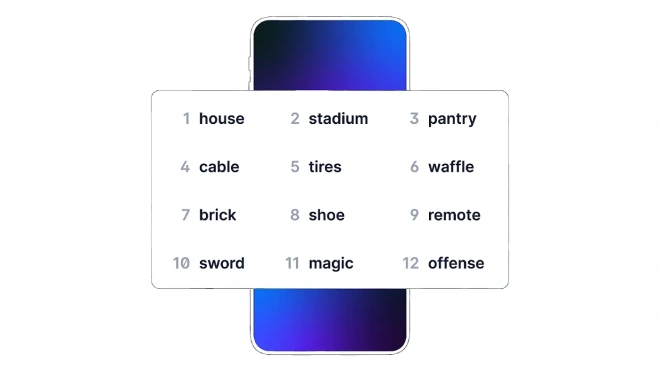
Usually a sequence of 12 or 24 words that can be used to recover a crypto wallet.
It is essentially a master backup.
If someone gets your seed phrase, they may be able to recreate the wallet and access its assets.
Source: https://www.blockchain.com/learning-portal/lessons/seed-phrases-explained
5. Gas
No petrol station required. Gas is the fee paid to process an action on certain blockchain networks.
Sending ETH, swapping tokens or interacting with a smart contract can all require gas.
Where you'll see it: Most commonly when using Ethereum and other smart-contract networks.
6. Smart contract
A smart contract is code stored on a blockchain that can automatically perform actions when certain conditions are met.
They are a major building block behind DeFi, NFTs, decentralised exchanges and plenty of other crypto applications.
7. DeFi
Short for decentralised finance.
DeFi describes blockchain-based financial applications that can offer things such as trading, lending and borrowing without relying on the traditional structure of banks or brokers.
8. DEX
A decentralised exchange.
Instead of depositing assets with a centralised platform, users generally trade directly through smart contracts using their own crypto wallets.
9. Staking
Some blockchains allow holders to lock or commit assets to help operate and secure the network.
In return, participants may receive staking rewards.
Ethereum and Solana are two well-known proof-of-stake networks.
10. Stablecoin
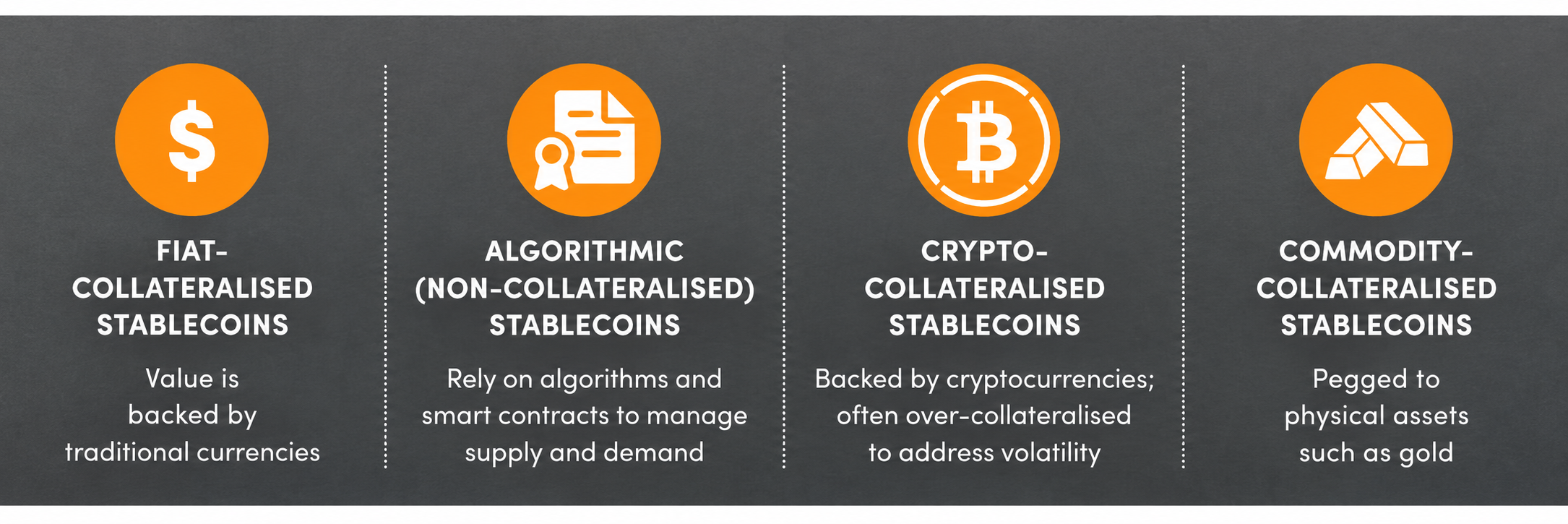
A crypto asset designed to maintain a relatively stable value, usually by tracking something else.
For example, USDC and USDT are designed to track the US dollar and AUDF is the same for the Australian Dollar.
The word "stable" describes the target, though. It doesn't mean every stablecoin is guaranteed to maintain its peg.
Source: https://ca-lab.isca.org.sg/technicalities/stablecoins-101-part-1/
11. Layer 1
The main blockchain itself.
Bitcoin, Ethereum and Solana are examples of Layer 1 networks.
12. Layer 2
A network built on top of another blockchain to help process transactions more efficiently or cheaply.
Ethereum Layer 2 networks are probably where you'll encounter the term most often.
13. Bridge
A blockchain bridge allows assets or information to move between different blockchain networks.
Think Ethereum to another network rather than Melbourne to Sydney.
Bridges have also historically been attractive targets for hackers because they can control large pools of crypto.
14. Market cap
Short for market capitalisation.
In crypto, it is generally calculated as:
Token price × circulating supply = market cap
It helps explain why a token worth $0.01 isn't automatically "cheap" compared with Bitcoin.
15. Liquidity
Liquidity describes how easily an asset can be bought or sold without significantly moving its price.
Large markets such as Bitcoin generally have deeper liquidity than tiny tokens with very little trading activity.
16. Airdrop
Free tokens, sort of.
Crypto projects sometimes distribute tokens to users who previously interacted with a network, held another asset or completed certain activities.
Airdrops became so popular that airdrop farming emerged, where users deliberately interact with projects hoping to qualify for a future distribution.
Now for the crypto internet dictionary
This is where things get less technical, and considerably weirder.
17. HODL
Yes, it is intentionally misspelled.
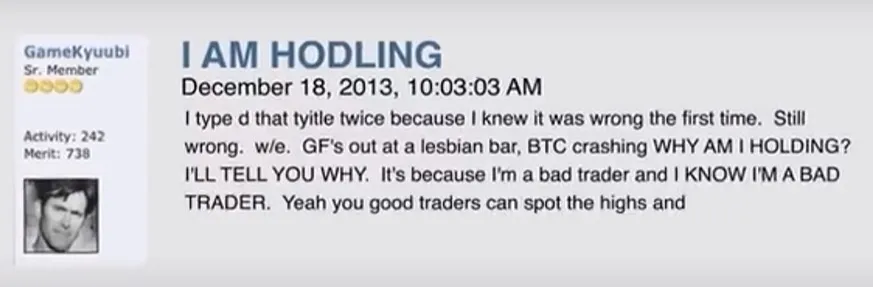
HODL came from a famous 2013 Bitcoin forum post titled "I AM HODLING" and became crypto slang for continuing to hold an asset despite market volatility.
Eventually people jokingly turned it into "Hold On for Dear Life", although that wasn't the original meaning.
Source: https://bitcointalk.org/index.php?topic=375643.0
18. FOMO
Fear Of Missing Out.
Bitcoin jumps, everyone starts posting screenshots and your group chat suddenly becomes a macroeconomic research desk.
That's FOMO.
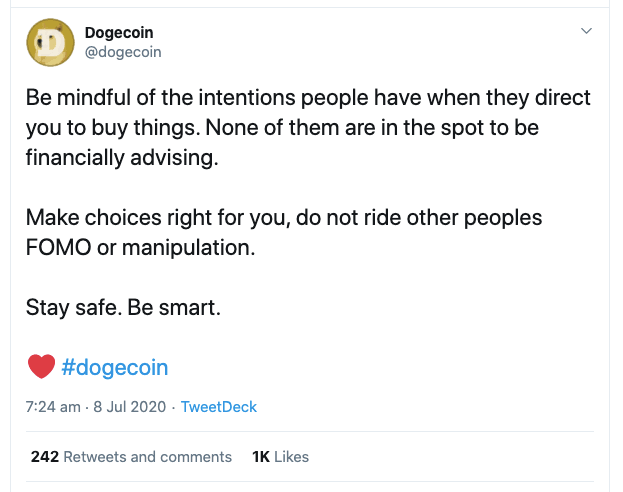
It describes the feeling that everyone else is making money from something and you're being left behind.
Dogecoin said it best:
Source: https://x.com/dogecoin?lang=en
19. FUD
Fear, uncertainty and doubt.
Crypto communities often use "FUD" to describe negative news, rumours or criticism surrounding a project.
Sometimes something really is FUD, Sometimes people just don't like what they're hearing.
20. Diamond hands 💎🙌
Someone who refuses to sell despite major price swings.
If a token falls 40% and they're still posting bullish memes, they may describe themselves as having diamond hands.
The opposite? Paper hands.
21. Whale 🐋
Someone holding a very large amount of a cryptocurrency.
When whales move large amounts of Bitcoin or another asset, blockchain trackers and crypto social media tend to notice.
22. GM
Good morning.
That's it. Crypto communities somehow turned saying "GM" into a cultural institution.
You will regularly see posts containing nothing more than: gm
Sometimes that's the entire post.
23. WAGMI / NGMI
WAGMI: We're All Gonna Make It.
NGMI: Not Gonna Make It.
They're usually jokes. Buying the dip? WAGMI.
Sending your seed phrase to "Ethereum Support" in a Telegram DM? NGMI.
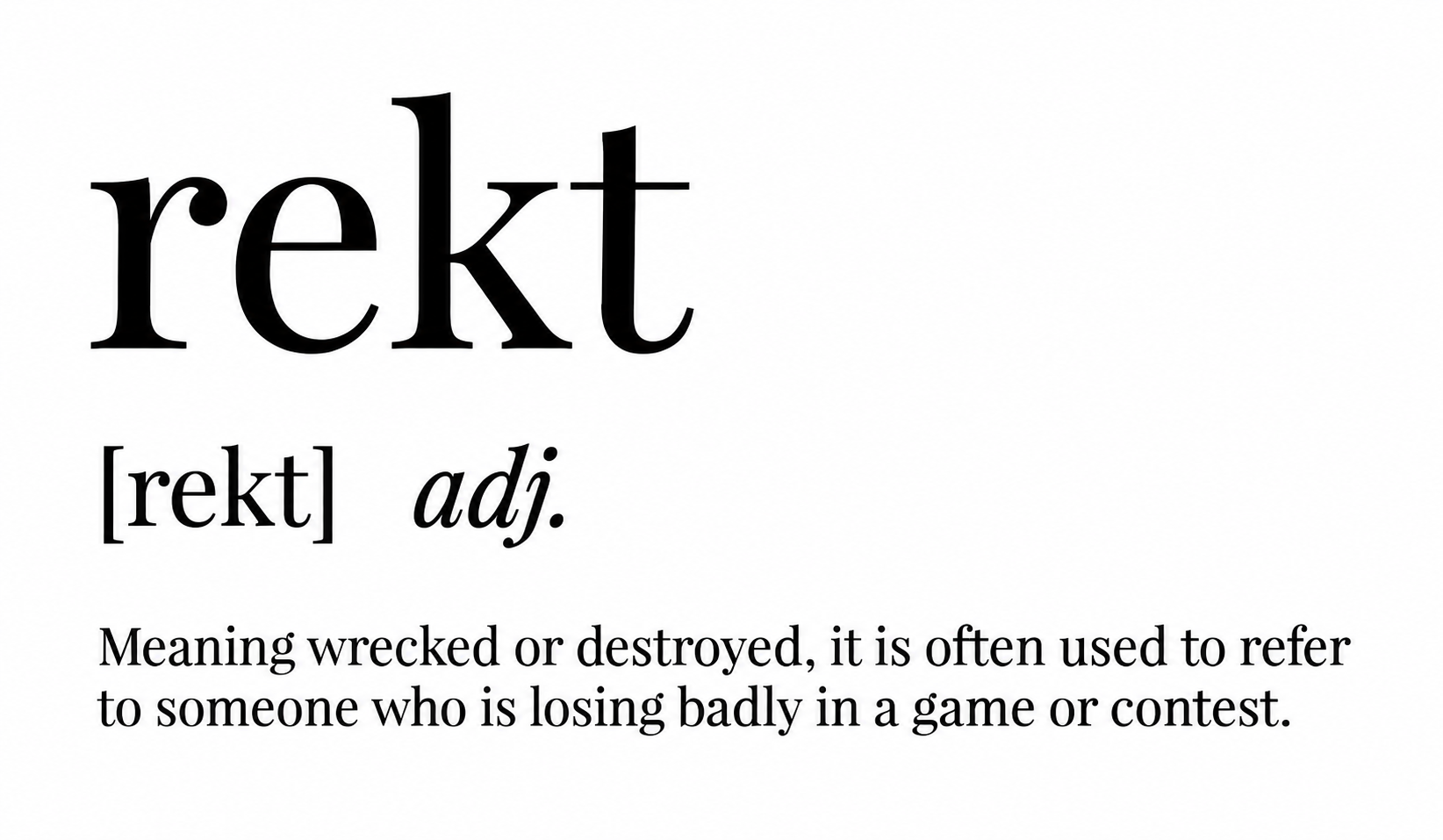
24. Rekt
Short for wrecked.
Usually used when someone suffers a particularly brutal trading loss or liquidation.
"BTC dropped 10% and leveraged traders got rekt."
Crypto is nothing if not compassionate.
25. Degen
Short for degenerate.
A degen is someone who dives into the riskier, more speculative corners of crypto, often involving new tokens, meme coins, DeFi protocols or whatever launched approximately six minutes ago.
The term can be insulting, crypto people also regularly use it to describe themselves.
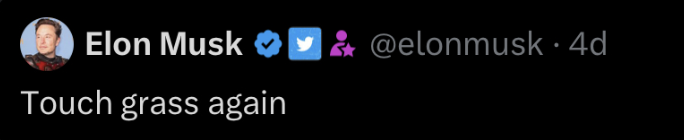
Bonus: Touch grass 🌱
My personal favourite.\ \ Crypto markets trade 24/7, crypto X (Twitter) also appears to operate 24/7. So occasionally, someone needs to be told to touch grass.
It basically means: log off, go outside and reconnect with the real world.
Where you'll see it: Usually directed at someone who has spent far too long arguing about tokenomics, staring at charts or posting their 47th market prediction of the day.
Sometimes the best crypto strategy is closing the laptop for five minutes; touch grass.
Source: http://x.com/elonmusk
Speak fluent crypto yet?
Crypto jargon can make the industry look far more complicated than it actually is.
Once you understand terms like wallets, gas, staking and Layer 2s, a lot of the technical conversation starts making more sense.
When someone tells you they're a diamond-handed degen who aped into a token because of FOMO before getting rekt...
Well, now you understand that too.
gm.


