

The Weekly Wrap
Over the last 7 days:
- Bitcoin (BTC) up 7.31%
- Ethereum (ETH) up 15.57%
- XRP up 10.87%
- Solana (SOL) up 11.53%
Other movers:
Crypto markets are having a great week.
Total crypto market cap sits around $2.51T, up 6.64%, returning to levels last seen in early February.
ETF flows remained strong:
- BTC: +$767.33M
- ETH: +$160.82M
For airdrop farmers, OpenSea has delayed its $SEA token launch, citing market conditions as a factor in ensuring a stronger release.
Looking at year-to-date performance:
- BTC: -14.70% (previously down ~35% earlier this year)
- ETH: -20.52%
- Gold: +14.51%
- NASDAQ: -3.57%
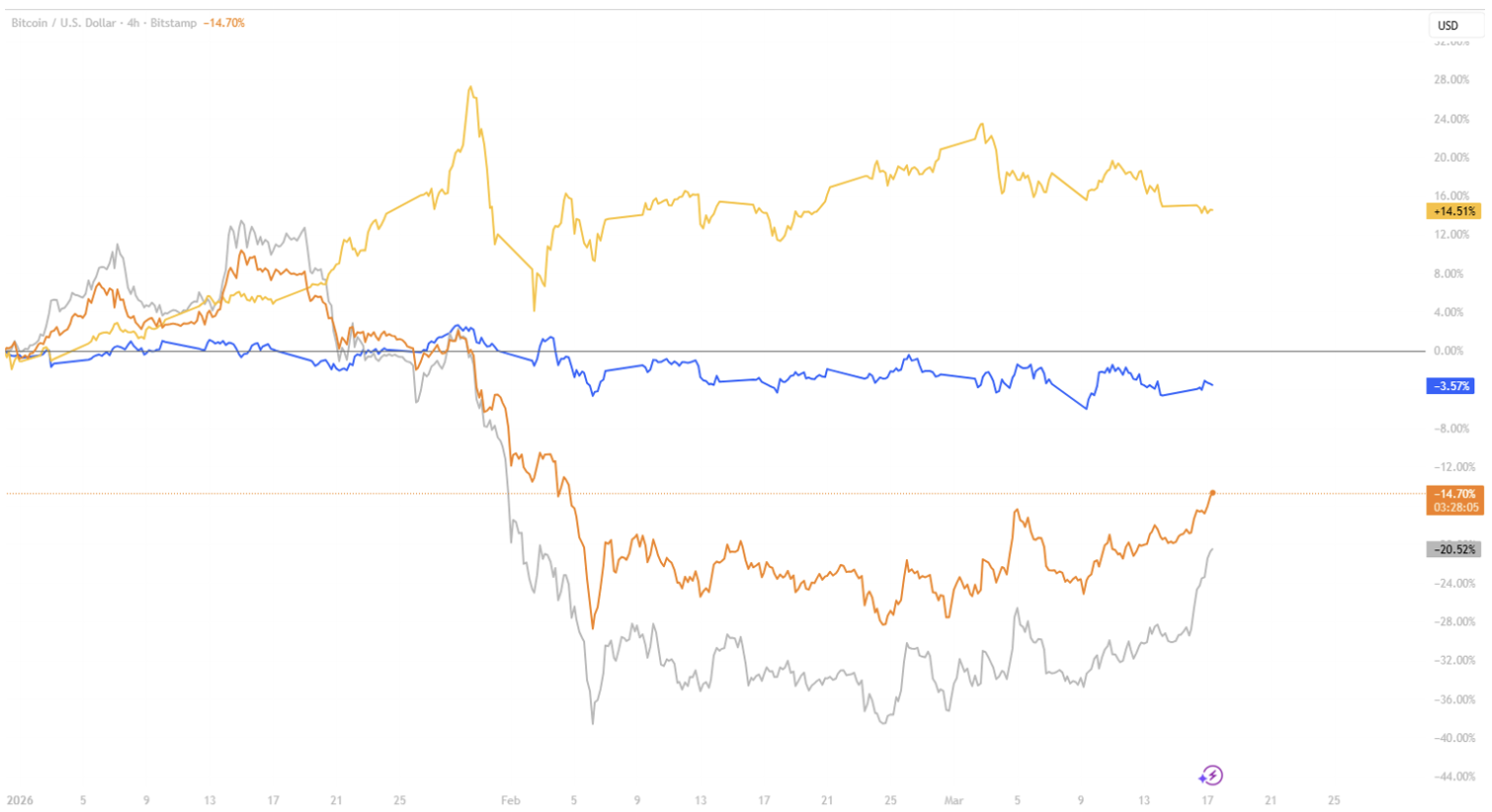
Source: tradingview BTC, ETH, GOLD, NASDAQ
Australian Macro:
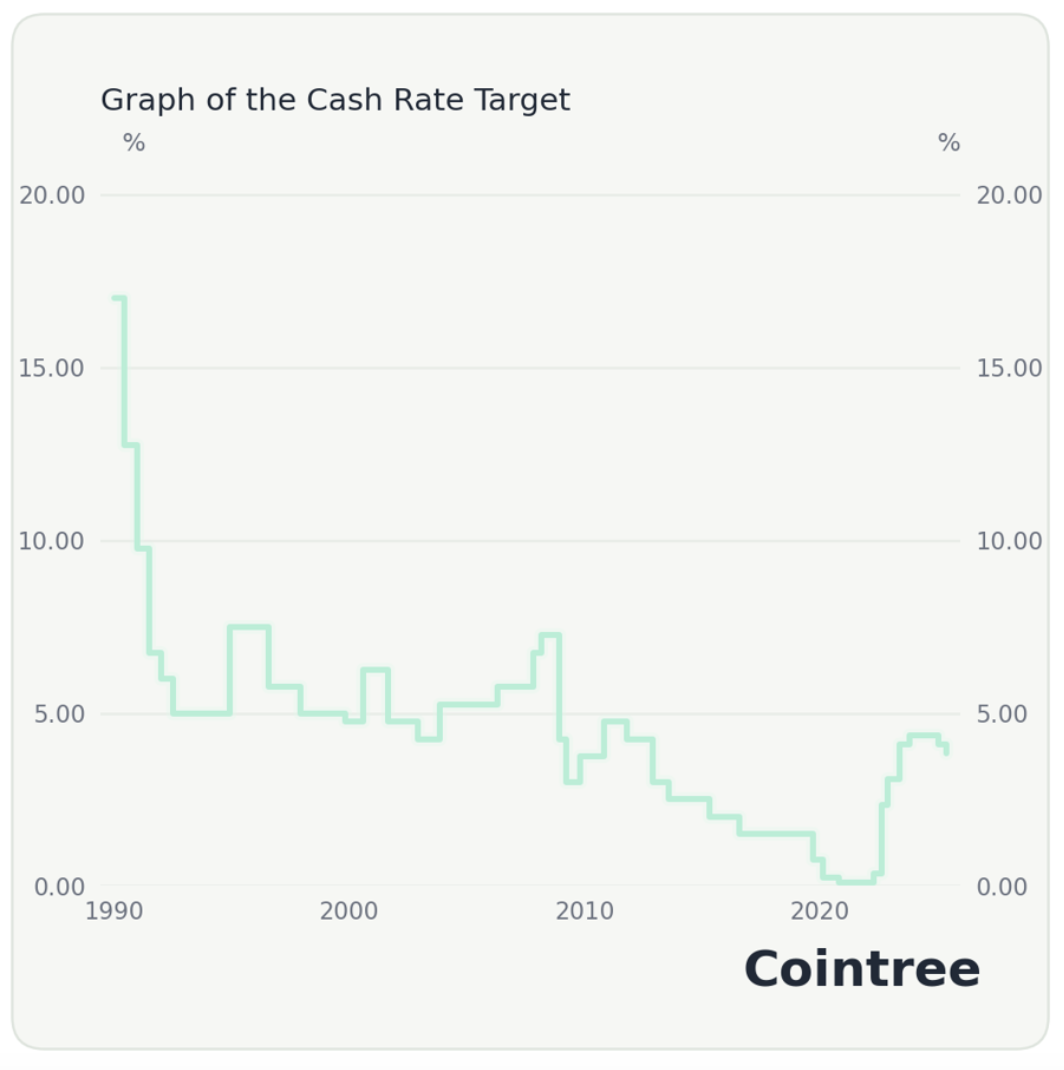
Australia’s central bank has lifted the cash rate by 25 basis points to 4.1%, citing persistent inflation risks, with Governor Michele Bullock warning that “inflation is likely to remain above target for some time” and that rising global pressures, including higher fuel costs, could keep price pressures elevated.
While acknowledging the strain on households, Bullock emphasised the priority remains controlling inflation, stating “we don’t want to have a recession, but if it’s hard to get inflation down then we’re going to have to deal with that,” highlighting the trade-off between price stability and economic growth.
Before we go hoarding oil like it is toilet paper again, it is worth remembering that geopolitical shocks tend to hit prices fast, not supply, with volatility rising short term before global supply chains adjust.
After the recent spike, oil has cooled off and is now sitting around the mid-range (50% retrace) of that move.
Price is holding a short-term upward trend, with markets stabilising following the initial reaction to headlines.
For now, markets are watching geopolitical developments closely as a key driver of oil price movement.
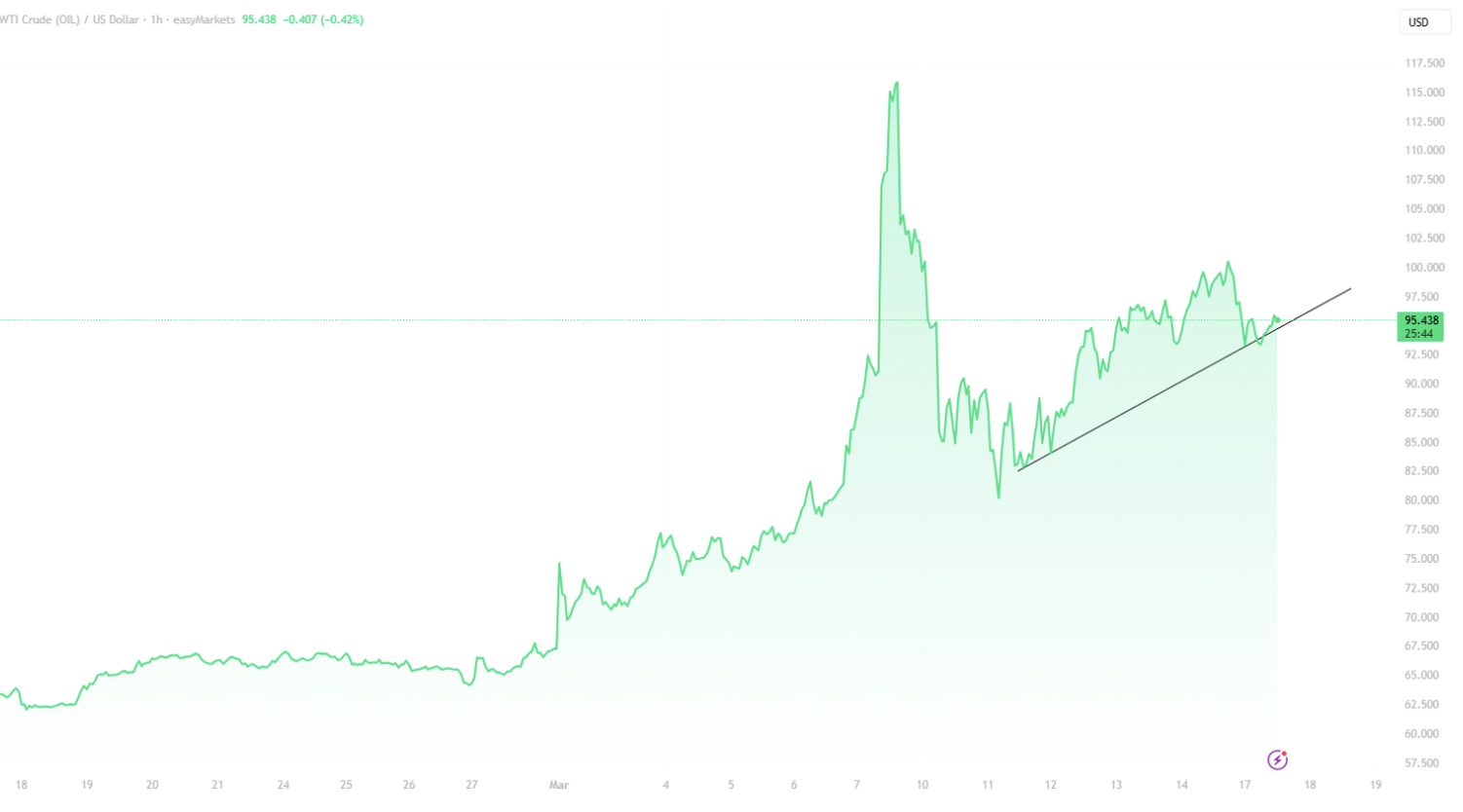
Source: tradingview OILUSD
BTC
Bitcoin is up 7.31% over the past 7 days.
Bitcoin’s recent move higher also brings CME futures gaps back into focus.
CME Bitcoin futures do not trade over the weekend, meaning sharp price moves during this period can leave “gaps” on the chart when markets reopen. These gaps represent areas where no trading occurred and are often watched closely by traders.
Historically, price has shown a tendency to revisit these levels over time, not as a certainty, but as part of normal market behaviour as liquidity is rebalanced and inefficiencies are filled.
With Bitcoin now pushing higher, any unfilled gaps below may act as areas of interest if price were to retrace.
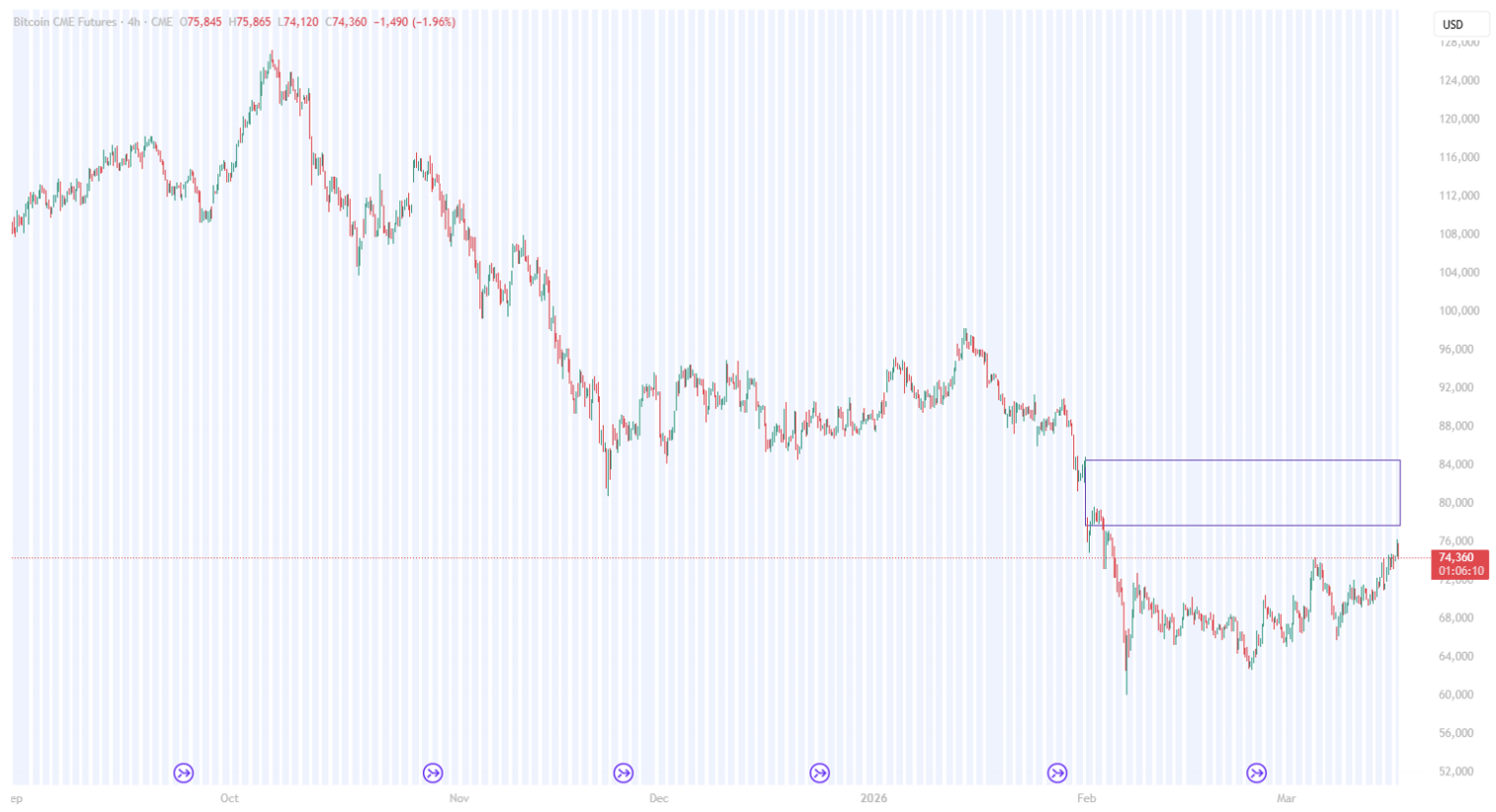
Source: tradingview BTC CME Futures
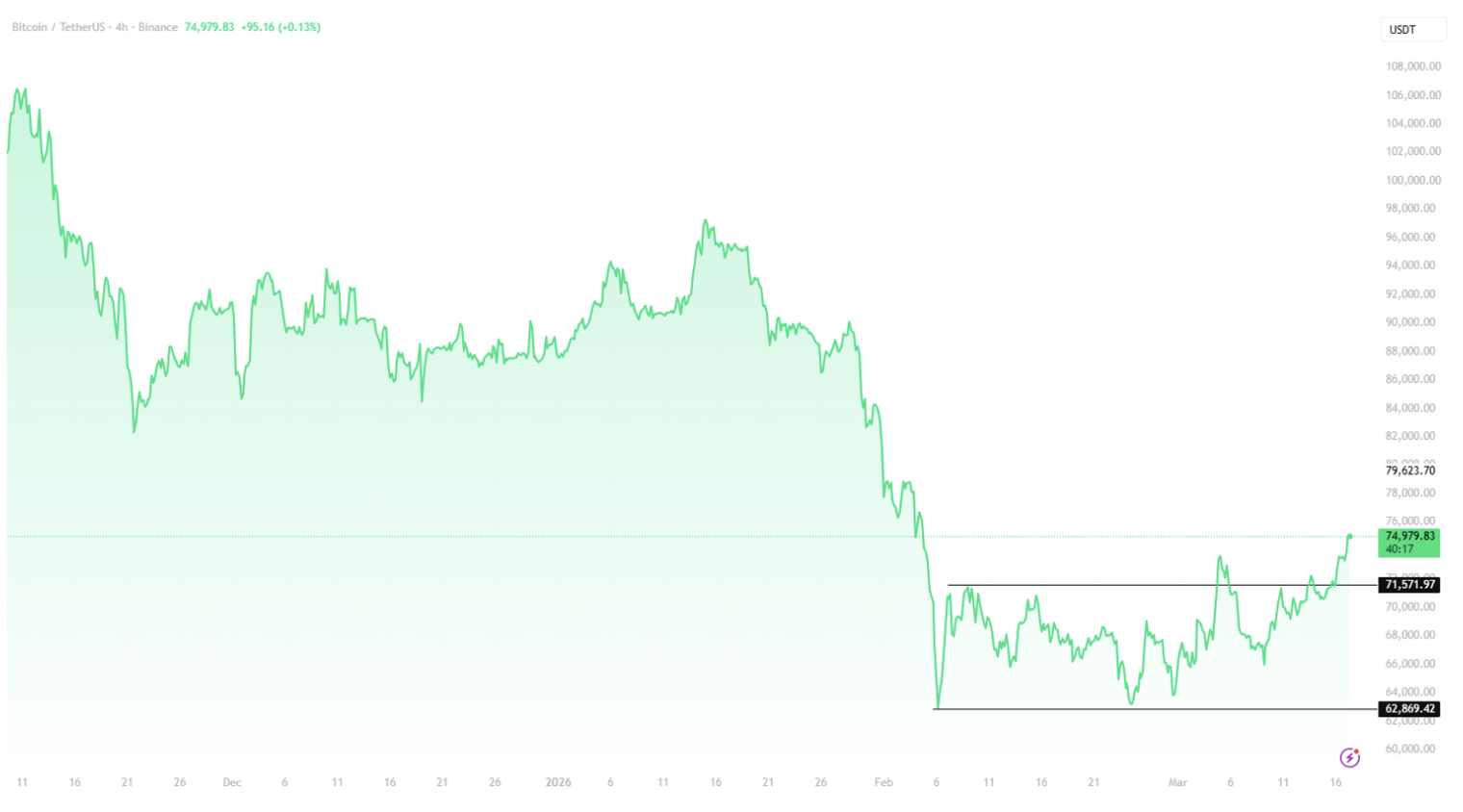
Bitcoin has broken out of its short term range (chart below) that had been forming since early February, pushing up toward $74,951 USD.
Price is now testing the top of this range, with $72,000 USD acting as a key level to watch. A sustained hold above this level would help confirm the breakout and signal a shift in short term momentum.
For now, the focus is on whether Bitcoin can maintain strength above this zone or falls back into the previous range.
Source: tradingview BTC/USDT
ETH
Ethereum is up 15.57% following the Ethereum Foundation’s new mandate and developments in ETF structure.
The mandate reinforces Ethereum’s long term direction, centred around self sovereignty, decentralisation, and maintaining core properties like censorship resistance, privacy, and security
At the same time, a key structural shift is emerging in traditional markets.
BlackRock recently launched the iShares Staked Ethereum Trust (ETHB), introducing staking into an ETF structure and adding a yield component to Ethereum exposure.
This introduces several structural considerations:
- ETH becomes a yield generating asset\ Unlike Bitcoin, Ethereum can produce staking rewards, meaning ETFs are no longer just tracking price but also generating income.
- Stronger institutional appeal\ Yield is a core driver for traditional portfolios. Staking introduces a new layer of return, making ETH more comparable to income producing assets.
- Potential structural demand\ If ETFs stake a portion of their holdings, this can reduce circulating supply while increasing long term lockup.
When paired with the Foundation’s focus on scaling Ethereum without compromising decentralisation, the addition of staking to ETFs highlights a broader shift.
Ethereum is increasingly being positioned not just as a network, but as yield bearing digital infrastructure focused on tech and innovation.
ALTCOINS
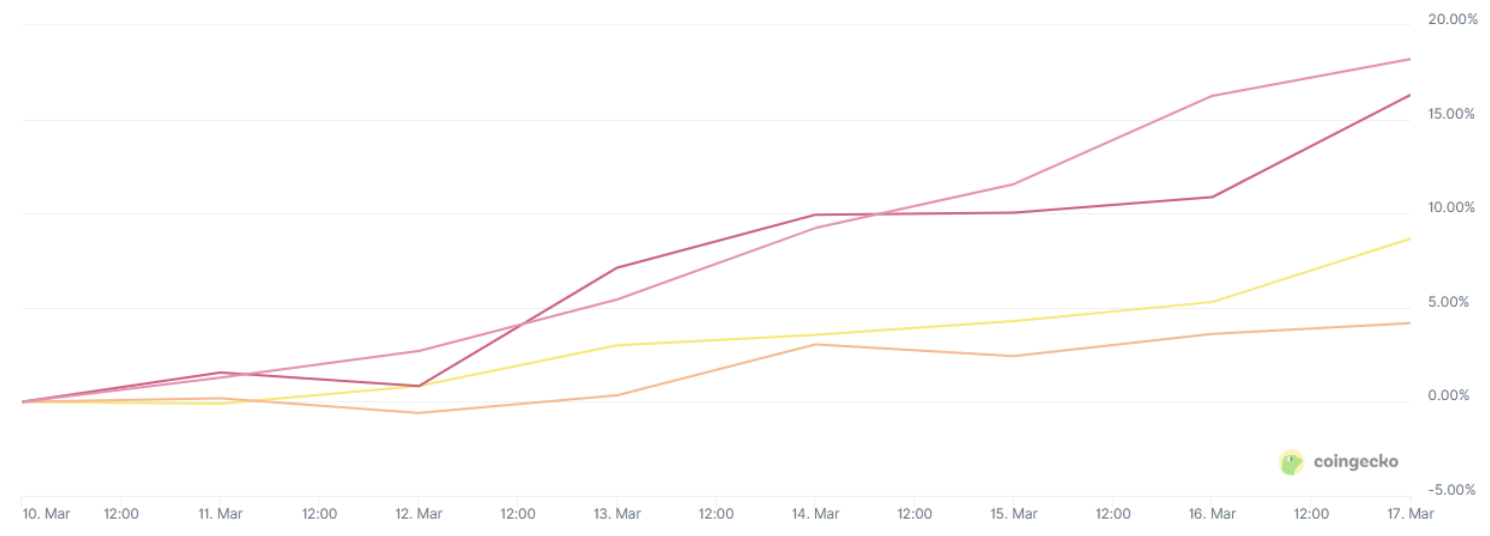
Lets have a look into some crypto categories this week.
Artificial Intelligence (AI) stood out as the strongest performer, climbing 18.20% over the past 7 days, continuing to attract attention across the broader market.
Memecoins also pushed higher, up 16.30%, reflecting continued speculative appetite and strong retail participation. TRUMP has pumped 27.19% over the past 7 days while BONK and PEPE have seen gains over 13% this week.
Decentralised Finance (DeFi) followed, gaining 8.67%, showing signs of renewed interest after a quieter period, with governance activity and protocol developments helping support momentum.
Real World Assets (RWA) lagged slightly in comparison but still posted a solid 4.18% gain, suggesting steady, rather than aggressive, capital inflows into tokenisation narratives.
Source: Coingecko categories
AAVE
AAVE had a strong week, up 14.49%, with price pushing higher alongside broader DeFi strength.
But the bigger story came from a $50M swap gone wrong.
A user attempted to swap a large position into AAVE through the Aave interface, but the trade ran into extremely low liquidity, causing massive price impact. The result was a near total loss, with roughly $50M ending up as just $36K worth of AAVE after multiple routing steps across different platforms.
Importantly, this wasn’t a protocol failure. The issue came down to market liquidity and execution size, with warnings reportedly shown but ignored before the trade was processed.
In response, Aave has announced a new safety feature called “Aave Shield.”
This will block swaps with more than 25% price impact by default, adding a guardrail to prevent similar high-risk trades from going through unnoticed.
The incident is a reminder that even in mature DeFi protocols, liquidity matters, especially when moving large size.
Price Action:
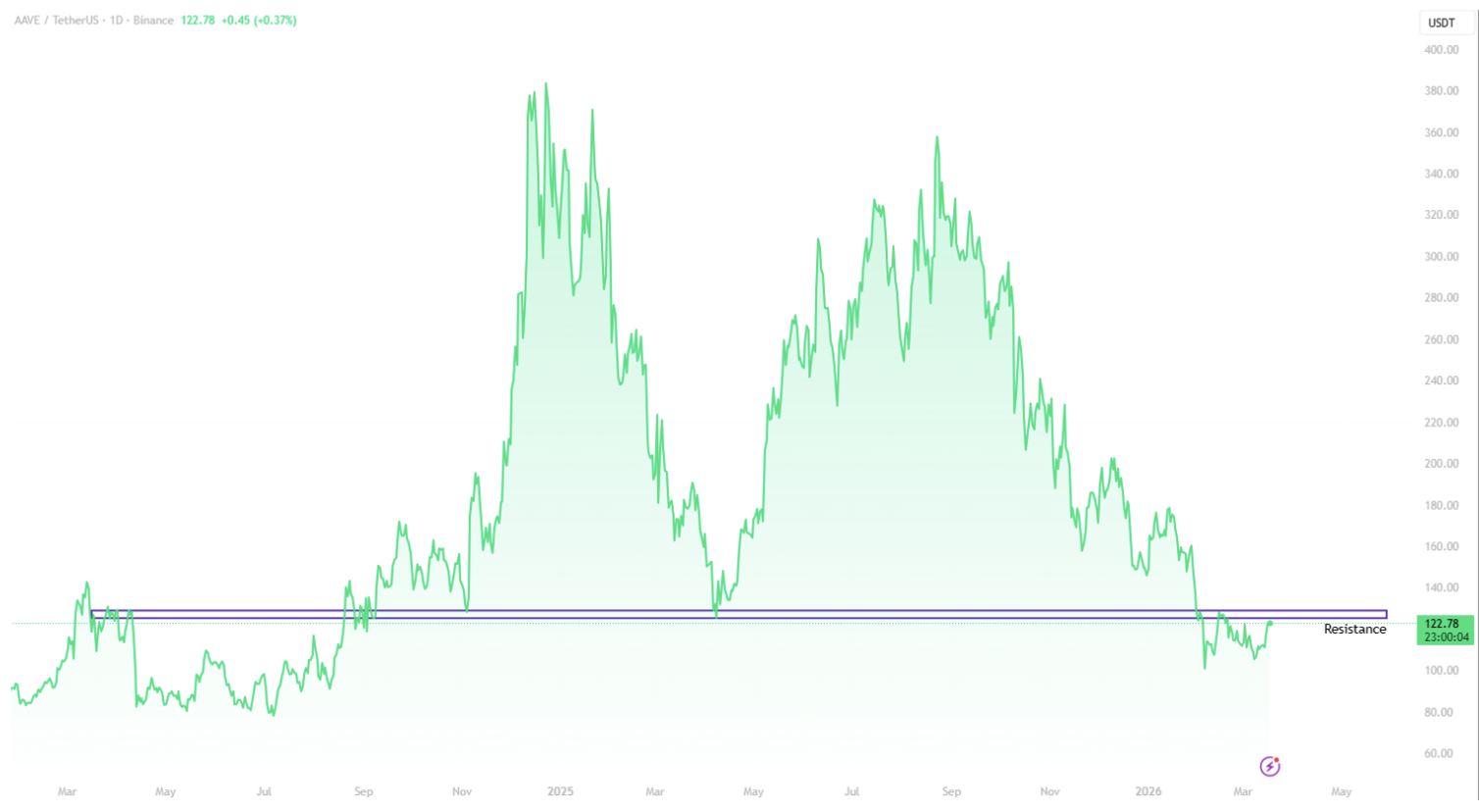
As per the chart below AAVE has bounced hard from recent lows, up around 20%, showing early signs of strength after a prolonged downtrend.
Price is now pushing into a key resistance zone overhead, an area that has previously acted as strong support before breaking down. These levels often flip into resistance, so this is an important test.
If AAVE can break and hold above this range, it would signal a potential shift in momentum. If not, we may see price continue to consolidate below resistance before the next move.
For now, all eyes are on whether buyers can push through and reclaim this level.
Source: tradingview AAVE/USDT
Stablecoins & Real World Assets
Stablecoins continue to cement themselves as one of the most important pieces of crypto infrastructure, and USDC has been one of the fastest growing players in that space.
USDC circulation recently rose 72% year-over-year to $75.3B, helping drive $733M in reserve income for Circle. The growth reflects a broader shift as stablecoins move beyond exchanges and become integrated with payments, fintech, and institutional infrastructure.
Part of that expansion is happening at the developer level.
Circle recently introduced Circle Skills, an open-source toolkit designed to help developers and AI agents build directly with USDC, EURC, and Circle’s developer platform. The tools guide AI coding assistants like Cursor, Claude Code, and Codex to follow best-practice patterns when integrating stablecoin payments, cross-chain transfers, wallets, and smart contracts.
As development workflows move from “read documentation → write code” to “prompt → generate output,” tools like Circle Skills aim to make stablecoin integrations faster and more reliable for developers.
The growth in stablecoins also ties closely to another expanding trend: tokenised real-world assets (RWAs).
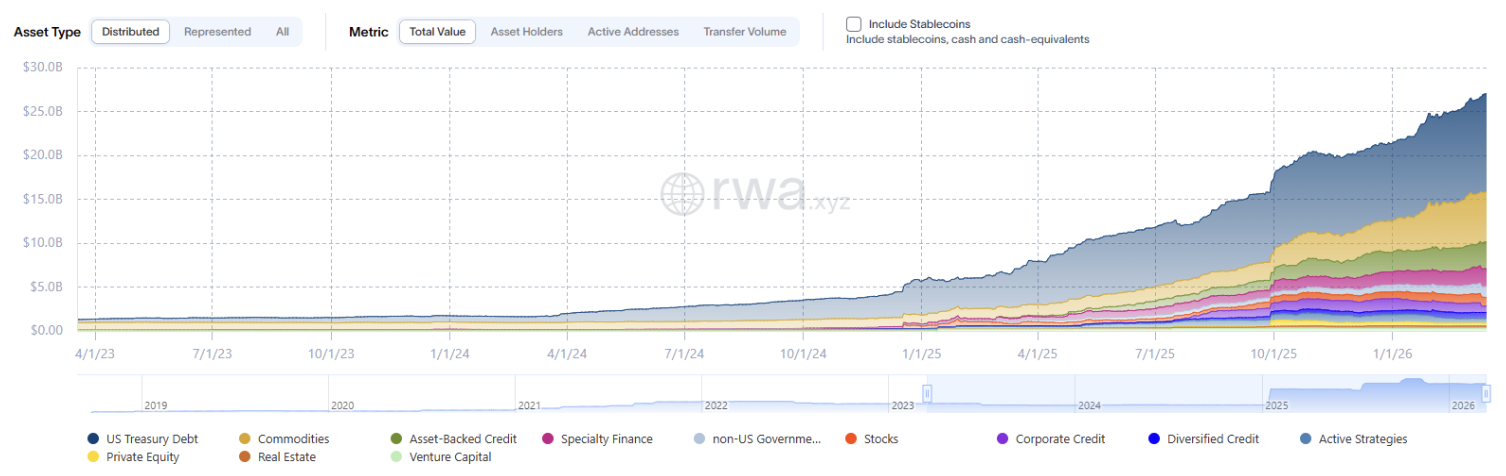
Looking at the chart above, tokenised assets have grown dramatically over the past two years, climbing toward roughly $27B in total on-chain value. Much of this growth is being driven by tokenised U.S. Treasury products, which now dominate the sector.
Total RWA Value:
Source: app.rwa.xyz
The connection between these two trends is important.
Stablecoins provide the settlement layer, while tokenised assets provide yield-bearing financial products that can exist directly on-chain.
As institutions continue exploring blockchain infrastructure, that combination of stable digital dollars and tokenised financial assets is becoming one of the clearest paths toward mainstream adoption.


